

The marketplace for companies prior to their initial public offering (IPO), or late-stage private equity, consists of established businesses with proven business models and considerable growth potential. Pre-IPO is the stage of the corporate life cycle where any necessary restructuring occurs. More experienced managers are brought into the company as needed, and corporate governance is strengthened to standards befitting a public corporation.
Funding for this stage typically comes from later-stage private funds (both venture capital and private equity) as well as crossover funds whose holding period is expected to span both the private and public phases of a company’s life. General partners in these strategies are often joined by co-investment from pensions, foundations, endowments, family offices, and, increasingly, ultra-high-net-worth investors. Pre-IPO placement can ensure funding stability and involve seasoned investors in corporate governance. While these investors are attracted to the significant return potential, they are also aware of the risks. Among the more prominent risks are a protracted time or complete failure to go public and the possibility of losing the entire principal. Participants in this nonpublic market should have access to a robust diligence process, as vital information must be sought out and uncovered by an experienced analyst or analyst team.
Conducting thorough diligence on these opportunities can be challenging, as they are not Securities and Exchange Commission–registered securities subject to timely and uniform disclosure of income, assets, and cash flows. Experienced analysts should be used to investigate and assess the competitive landscape in which a company operates, the direction the management team is taking, and, ultimately, the company’s growth prospects. The analysts need to build a narrative for the prospective investor explaining why this would be an attractive investment.
Because these companies are not yet beneficiaries of the liquidity generally available in public markets, investors may have to wait years for a liquidity event, usually an IPO or an acquisition. When some of these companies do eventually go public, investors should be prepared to withstand a lock-up period where they are not allowed to sell their shares for six months. The market wants to avoid owners selling with the sole purpose of cashing out, sometimes leaving the new stockholders with a shell company of little value. With the IPO route being the primary way for founders and early investors to gain liquidity, having a next-generation management team or a well-defined succession plan is an important element in the investment decision, as prospective investors will address these during the IPO road show.
Broader access
One of the more interesting trends in the private markets space over the last 10 to 15 years is the increasing democratization of investment products and opportunities, which were previously available only to sophisticated institutional investors. The availability of pre-IPO companies to investors considered to be “retail” is an extension of that trend. Merely meeting the qualifications for qualified purchaser or accredited investor opens the door to a new, often hungry cohort of potential investors with access to increasingly liquid secondary markets. As in most single-asset security classes, participants in the pre-IPO space are strongly encouraged to diversify appropriately across single opportunities and within industry and sector exposures. Participants do not need to be as diversified as a venture capital manager, as the underlying companies in the late stage are more mature. However, there are still enough ultimately disappointing investments in the space that investors should seek multiple opportunities and size their investments accordingly.
The ample availability of capital from both traditional and newer investors has allowed many of these companies to remain private for longer than in prior eras, when they would have needed public capital through IPOs to continue implementing their growth initiatives. Once these late-stage companies finally go public, they do so at much higher valuations. Recent examples include now well-known companies such as SpaceX, OpenAI, and Anthropic, which will likely go public soon, but at a market capitalization that will place them at the higher end of the large-cap universe. Most of the returns that would have been earned in the public markets as they moved through the small- and mid-capitalization maturity phases were captured by private investors. In some critical ways, late-stage private equity may be replacing small- and mid-cap public equity in earning the evidence-based size premium available to equity investors. To the extent equity investors should be considering the entire opportunity set of potential investments, failure to consider private equity will greatly alter and likely diminish the returns generated from taking on equity risk.
Evolving entry and exit opportunities
The private equity markets have transformed from an inefficient, fragmented market into an institutional marketplace with greater liquidity. As demand for investor access to this space has grown exponentially over the past decade, options have developed to match investors who want to get in with those who may want or need to get out. Several secondary marketplaces have emerged that match investors who need liquidity with those seeking substantial returns from single-company investments. Online sites like Hiive, Linqto, Forge Global, and EquityZen have purchase minimums ranging from $1,000 to $100,000.
Aside from investing in individual co-investment or direct investment opportunities, there are other ways for investors to access the space. Investing in the numerous pre-IPO or late-stage venture capital funds that are raising capital is probably the most basic way to gain access to these opportunities. Having a professional private markets investor who presumably employs an experienced due diligence team will best meet the analytical and diversification needs of this investment space. Some of these fund companies are publicly traded entities, so investors can also, or alternatively, participate in their success as fundraisers and ultimate investors by investing directly in their exchange-traded stocks.
Some investors access the pre-IPO space by buying the equity of publicly traded companies that regularly invest in private companies as a business line. An example would be Microsoft investing in the privately held but now exceptionally large OpenAI. More companies have been forming internal private equity investing teams to remain innovative and cutting-edge as they grow larger and often more bureaucratic and lethargic. Investors using this method to gain access to late-stage opportunities must recognize that these venture capital and private equity businesses are usually small business lines within the parent, so thorough analysis and appreciation for the other business lines should be conducted before making such an investment.
Of course, another way to access these investments is to wait and buy on the day of the IPO, where a strong growth company often earns a substantial premium above the offer price in the first few days of public trading. However, investors who elect to participate through buying from the so-called syndicate desks at the issuing investment banks must be prepared to participate in all the deals offered by that issuer, not only the “hot” ones. Some IPOs do not immediately trade above the offer price in public markets and actually decline by the amount of the selling concession that accrues to the broker who provided the opportunity. These investment banks also look for prospective investors who will maintain the position for a reasonable period, rather than “flipping” it for a quick profit.
Recent trends
The secondary marketplace for private equity once largely had an unsavory reputation as a place where desperate sellers would go to liquidate their limited partnership units at heavily discounted prices. However, after over a decade of economic expansion and mostly bull markets, there was a dearth of sellers who needed to sell at such deep discounts. With demand for secondary opportunities growing and seeking to improve its reputation, the secondary market largely reinvented itself as a space where both sellers and buyers can receive a perceived fair price.
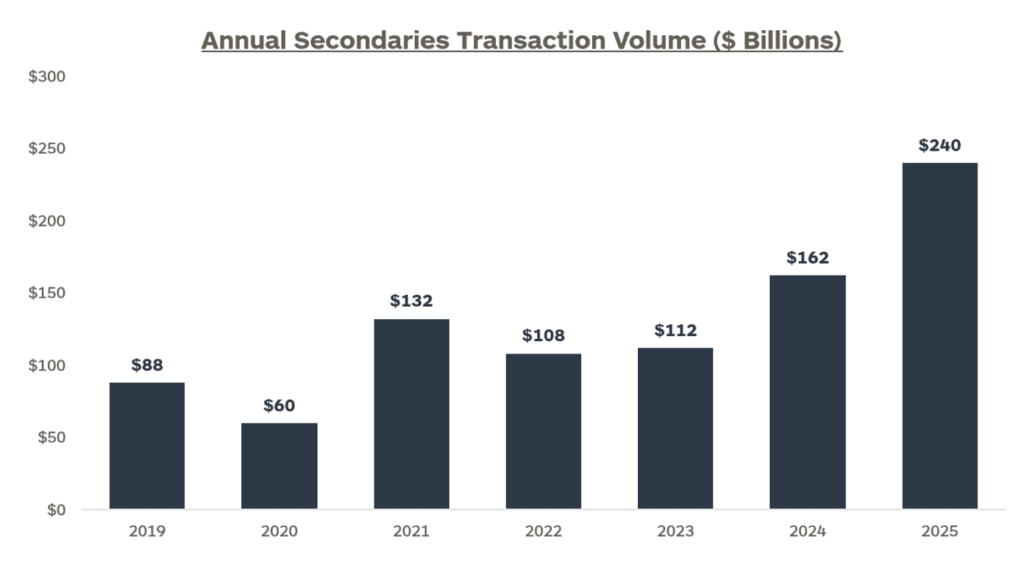
Source: Jefferies Global Secondary Market Review, February 2026, Cerity Partners
One solution that has emerged as employee shareholders seek liquidity options is Nasdaq Private Market (NPM), which completed approximately $15 billion in tender offers in 2025. As companies remain private longer, NPM’s secondary marketplace provides an important liquidity source ahead of traditional IPOs or acquisitions. A liquidity event as an employee of a private company involves distinct financial and tax considerations that merit thoughtful analysis. Cerity Partners serves as the exclusive wealth advisor to NPM clients, helping participants address these implications.
Emanating from the slow IPO and mergers-and-acquisitions environment of the early part of this decade, the advent and proliferation of continuation funds have been an effective way for general partners of private equity funds to provide liquidity to their limited partners while retaining ownership of their stronger portfolio companies. With interest rates coming down and the U.S. economy continuing to grow, there has been a notable pickup in the more traditional exit avenues of IPOs and mergers and acquisitions.
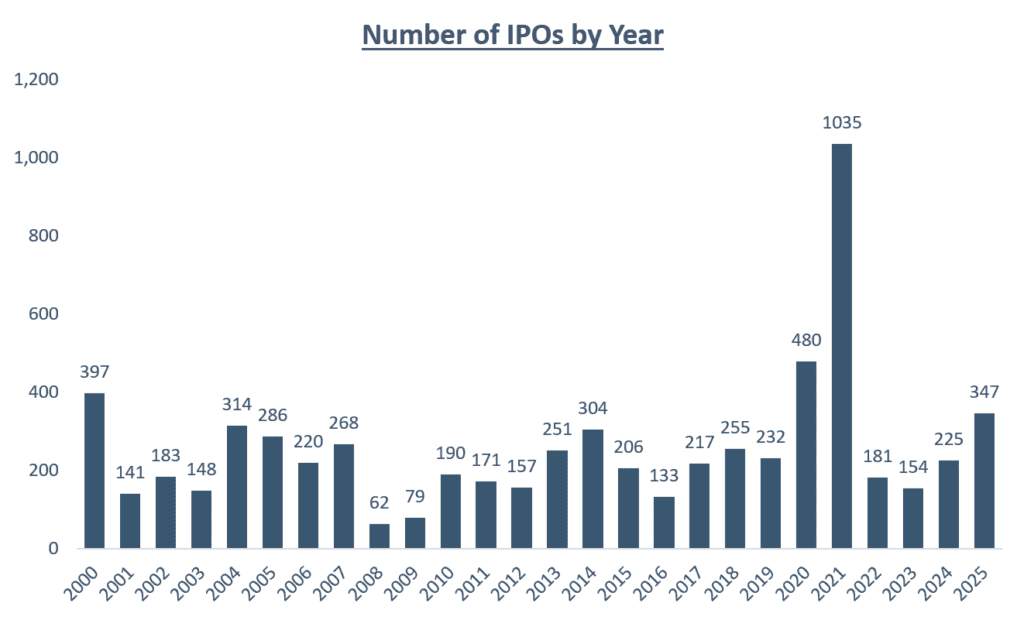
Source: Jefferies Global Secondary Market Review, July 2025, Cerity Partners
Investors in private equity should always be aware that they will be sacrificing liquidity for the promise of strong returns, but developments over the past few years in matching buyers and sellers are likely to somewhat mitigate this illiquidity risk without heavily penalizing returns. For more information about investing in pre-IPO or private market opportunities, reach out to your Cerity Partners advisor or request an introduction today.
Please read important disclosures here.