

Download this week’s full edition!
The Supreme Court’s ruling that International Emergency Economic Powers Act tariffs were unconstitutional offers only temporary trade relief, as the administration is pivoting to alternative legal authorities—leaving significant uncertainty about the ultimate shape of US trade policy.
What caught our eyes this week
Still more questions than answers on trade policy
Friday’s Supreme Court tariff ruling didn’t do much in the way of reducing trade uncertainty. We now know that the president’s reliance on IEEPA was unconstitutional. But we still don’t know how refunds might work for the estimated ~$130 billion in tariffs paid. Without direction from the Supreme Court, expect any process to be litigious and drawn out. President Trump took a first step in replacing IEEPA tariffs with a 15% universal tariff through Section 122 of the Trade Act of 1974. This has a limit of 150 days (unless extended by Congress, which is unlikely given upcoming midterms). The tariff will buy the administration time to conduct country-by-country investigations into “unfair trade practices” via Section 301 of the Trade Act of 1974 that would authorize unlimited tariffs for the remainder of Trump’s term. Sectoral tariffs under Section 232 of the Trade Expansion Act of 1962 also remain in effect. So, what is the ultimate landing point for trade policy? We still don’t know. We get some temporary relief, but that will dissipate as Section 301 tariffs kick in. Then throw in the renegotiation of existing trade deals (including a review of the United States–Mexico–Canada Agreement due this summer).
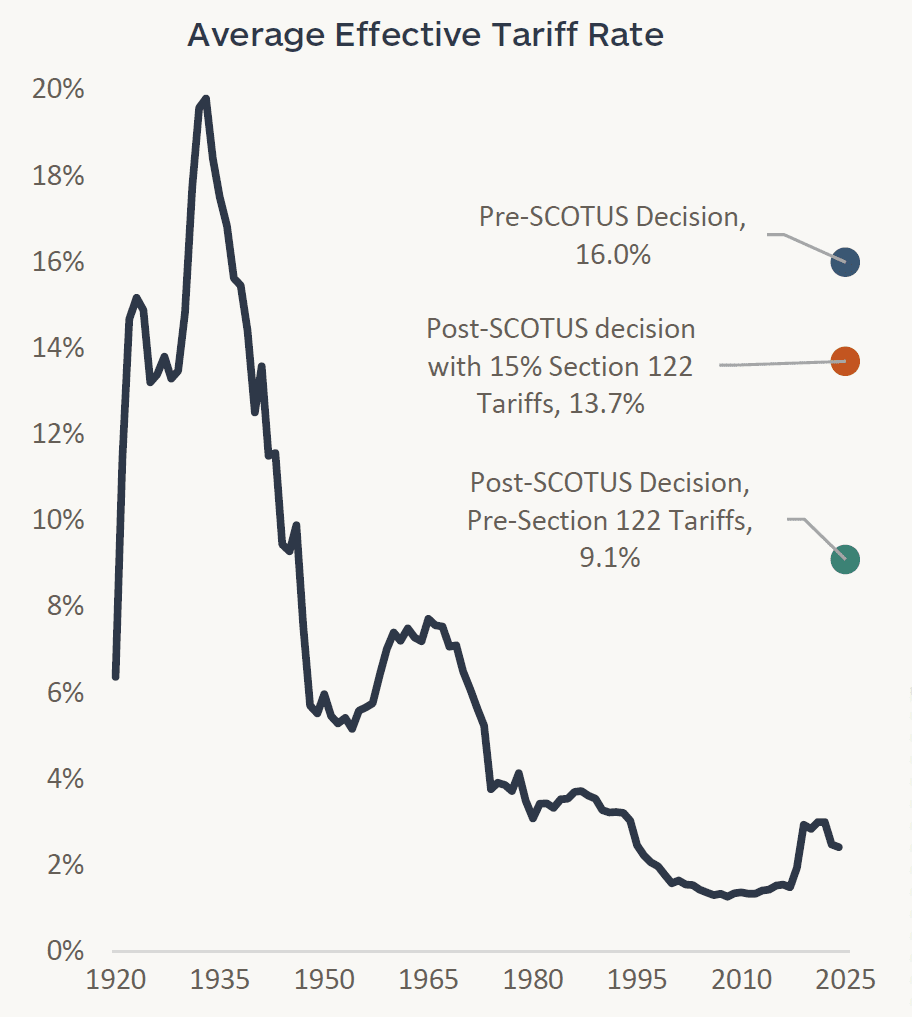
CHART OF THE WEEK: Cerity Partners, Yale Budget Lab “State of U.S. Tariffs,” February 21, 2026. Effective tariff rates are as projected by the Yale Budget Lab, before substitution impacts.
Past performance does not guarantee future results.
Please read important disclosures here.