
Key takeaways
- Energy markets are the primary economic transmission channel. The US has limited direct exposure to Persian Gulf supply disruptions thanks to the shale revolution, but oil prices will still be affected—the magnitude depends on the duration and severity of the conflict.
- Oil price spikes may not be sustained. History shows that even prolonged conflicts (e.g., Russia-Ukraine) can produce only brief commodity price spikes, and OPEC has signaled a willingness to increase production, which could help cap prices.
- The impact on corporate America is likely manageable. Key domestic growth drivers—AI infrastructure buildout, supply chain reshoring—are structural in nature and unlikely to be derailed by Middle East conflict. Historically, geopolitical shocks have had limited lasting impact on US corporate earnings.
- Higher oil prices further complicate the path for monetary policy. A sustained rise in oil prices could reignite inflationary pressures, potentially delaying the Federal Reserve’s easing plans—a near-term headwind for markets.
- Broader geopolitical ripple effects bear watching. Depleted US munition stockpiles, China’s posture toward Taiwan, and strained global alliances add layers of uncertainty beyond the immediate conflict.
What we know and what we don’t know
The events over the weekend in Iran introduced considerable uncertainty to the trajectory for global economies and financial markets. The situation is fluid, but based on comments from President Donald Trump, we should brace for a multiweek campaign. As we think through the range of potential impacts, we feel a dose of humility is prudent. As always, we don’t know what we don’t know, and the proverbial “fog of war” only serves to exacerbate this dynamic. Only the passage of time will tell the outcome. With that said, here are our thoughts on the situation as we see it (given the facts as of the morning of March 2).
The energy impact
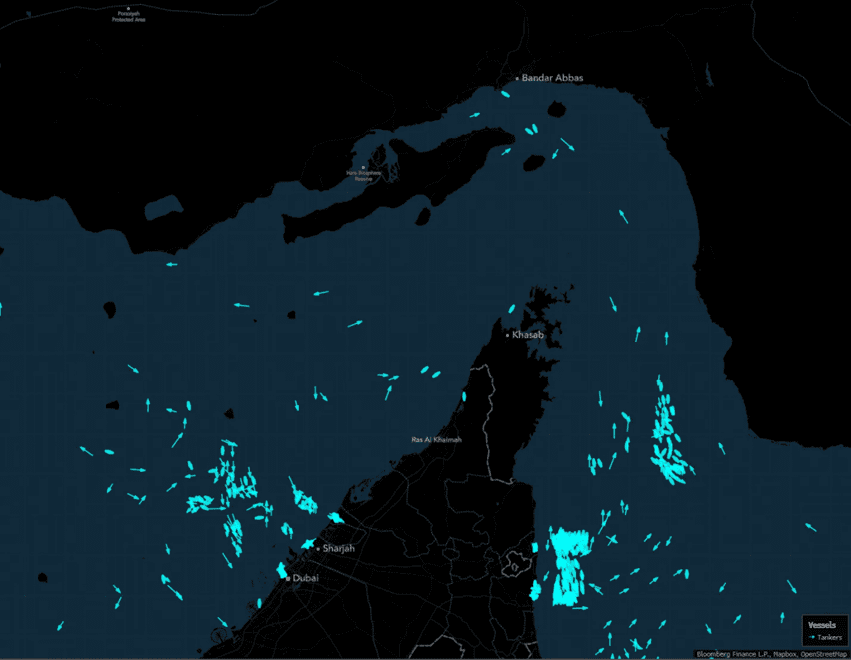
As is typical with geopolitical issues in the Middle East, the primary conduit for global economic impact is through energy markets. From our perch in the United States, largely thanks to the shale revolution, very little of the oil and gas we import and consume needs to sail through the Strait of Hormuz. This means that, unlike parts of Europe and Asia, disruptions in the Persian Gulf have a negligible impact on our access to energy. However, they can certainly impact the price we pay for it. Oil tankers are receiving mixed messages as to whether the Strait of Hormuz—through which nearly a quarter of the world’s oil traverses—remains open for business. Regardless, they aren’t taking any chances. We are also hearing early reports that energy facilities in the region are being impacted: natural gas facilities in Qatar and oil refineries in Saudi Arabia, for example. As expected, the market’s immediate response is to send energy prices higher.
Figure 1: Oil tankers pile up on both sides of the Strait of Hormuz
Source: Bloomberg, 3/2/2026.
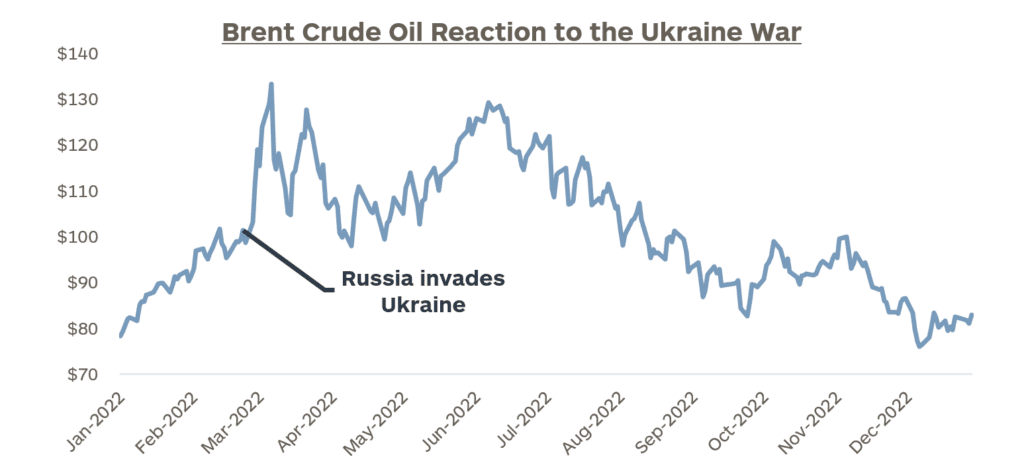
Even in the event of a more prolonged conflict, history tells us that market behavior can often be surprising. For example, after spending weeks rising amid reports that Russian troops were building along the Ukraine border in early 2022, oil prices spiked dramatically after news broke of the invasion on February 24. However, the spike over the following days ultimately marked a high point for crude oil that still holds to this day, even as that particular war continues to rage on. In other words, even if you knew upfront that the war in Ukraine would ultimately stretch on for more than four years, you would have lost money trying to buy oil for all but the briefest of windows in the very beginning. We don’t want to understate the gravity of the situation, but we take dramatic calls for massive and sustained increases in oil prices with a grain of salt. The commodity market is a fickle beast, and predicting a direction involves deciphering a massive and intertwined web of supply and demand.
Source: YCharts, Cerity Partners
A new risk for stocks to digest
Equity market reactions to geopolitical events tend to be knee-jerk in nature as investors struggle to price in a new risk. Over time, historical analogs tell us that, usually, the ultimate impact to corporate earnings in the United States is limited, and stocks eventually trade in line with that reality. There is risk, as there always is, that this time is different. There are cases in history where this time was indeed different. One would not have been wise to brush off the initial market impact of the Yom Kippur War and resulting Arab Oil Embargo. But we take some comfort in a relative degree of insulation enjoyed by many of today’s drivers of the US economic picture, and by extension the corporations that operate within it. The extraordinary build-out of infrastructure to support advancements in artificial intelligence is structural in nature and unlikely to be deterred by conflict in the Middle East. Similarly impressive efforts to facilitate the reshoring of supply chains are likely to continue as planned, if not accelerate. Outside of a potential squeeze from gas prices, the impact to US consumers could be limited, and sentiment-driven changes in behavior are likely to be fleeting. One potentially meaningful near-term impact could be higher oil prices causing a delay in the Federal Reserve’s plans to continue easing monetary policy—a development that would likely disappoint equity markets.
The longer-term view
What does this all mean over the longer term? US munition stockpiles have been depleted from the current conflict, as well as the Ukraine War, Israel–Hamas conflict, and other activities (e.g., Venezuela, Nigeria, Yemen) and will need to be replaced. Arms production will take time and cost money (reminder that President Trump has called for a $1.5 trillion defense budget). Any prolonged increase in oil prices risks a reacceleration of inflationary pressures through higher gas prices for consumers and increased intermediate costs for producers. Foreign adversaries are also keeping a watchful eye on our actions abroad. China could see depleted US military capacity as a good time to ramp up hostilities against Taiwan. As the main buyer of Iranian oil, China feels the impact of these actions as much as anyone outside the Persian Gulf. Already on his heels in a position of relative economic weakness, President Xi Jinping could use the conflict as political cover to further his own interests in some fashion. Elsewhere, recent displays of aggressiveness in US foreign policy (both verbal and physical) could push certain countries away, curbing any effectiveness of alliances that have already been strained by trade policy. European nations are closer to the fight and may now have even greater incentive to accelerate defense spending.
One of many other questions that looms large is what the future looks like for Iran, its government, and its people. President Trump has been clear in his intention to effectuate regime change. But true, lasting change requires more than the removal of a head of state and damage to military capabilities. There appears little appetite for US troops to stick around and attempt to facilitate such change as they did in Iraq and Afghanistan. Those experiences highlight the potential for prolonged disorder and violence that can supersede regime change. At the same time, the relative calm after leaders were deposed from Venezuela and Syria show that chaos in the aftermath does not always happen. At home, public opinion will be largely influential in determining a path forward, particularly as midterm elections loom. The direction of the US dollar will serve as another implicit barometer for the global perception of US foreign policy.
For our part, we continue to monitor the situation closely and will communicate with you as events develop. In the meantime, we believe the most constructive course of action is the one that has served investors well through prior periods of geopolitical upheaval: maintaining a diversified portfolio aligned with your long-term objectives, resisting the impulse to make sweeping changes based on headlines, and staying in close contact with your advisory team. Periods of uncertainty are uncomfortable, but they are not unfamiliar—and portfolios built to weather a range of outcomes are designed precisely for moments like these. As always, please don’t hesitate to reach out to your Cerity Partners advisor with questions or concerns. If you don’t have an advisor, request an introduction today.
Please read important disclosures here.