

Download this week’s full edition!
Conflict in the Persian Gulf has disrupted global oil supply, and while the US maintains energy independence, the fungibility of crude oil means Americans are already feeling the effects at the pump—with gas prices up over 25 cents per gallon—and elevated prices could put upward pressure on CPI in the months ahead.
What caught our eyes this week
Feeling it at the pump
The global energy outlook is growing increasingly severe as war in the Persian Gulf begins to disrupt supply. With the Strait of Hormuz effectively closed, shipping backlogs and constrained storage capacity are forcing a few gulf nations to cut production. Getting that production back online when ready will take some time. In the United States, very little of the crude oil we consume comes from the Middle East. Thus, the concern for us is not whether we have access to oil—we do and we will—but rather what price we will pay for it. Even with our energy independence, the fungibility of crude oil makes full immunity impossible. After the first week of the war, gas prices are already up over 25 cents per gallon across the country. Luckily, we’re coming off a low base after cheap gas in 2025, but that might make year-over-year figures look rough in the next few months. The graph shows some estimates for what impact different gas prices could have on year-over-year headline Consumer Price Index (CPI) if prices are still elevated come May. It considers just the mechanical flow-through of gasoline to CPI, not accounting or any other knock-on effects, and is based on a $3.16 per gallon national average as of May 2025 and gasoline’s 2.9% weight in the CPI.
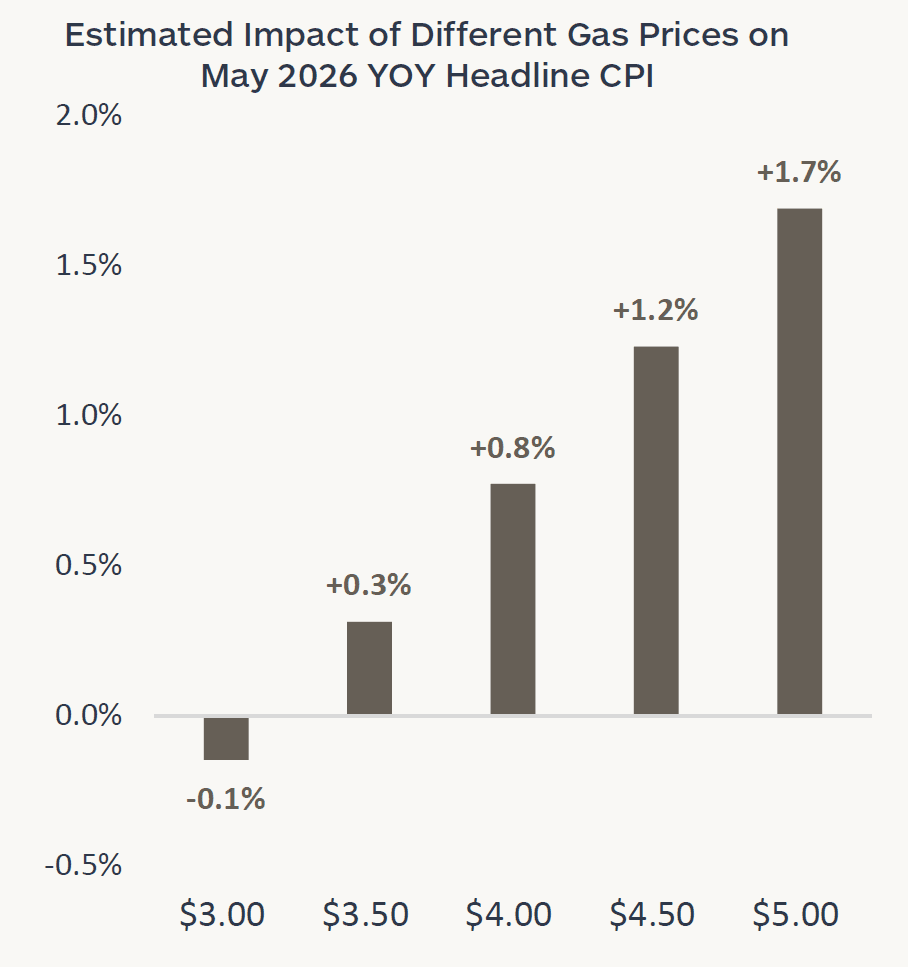
CHART OF THE WEEK: Cerity Partners, Energy Information Administration, Bureau of Labor Statistics, 3/8/2026. Calculation assumes $3.16 national average at the end of May 2025 and 2.9% weighting of gasoline in the Consumer Price Index.
Past performance does not guarantee future results.
Please read important disclosures here.