

Q1 2026 in review
The defining event of the first quarter of 2026 was the joint US-Israeli military campaign against Iran, which began on February 28. The conflict upended what had been a cautiously optimistic start to the year, injecting extraordinary volatility into energy markets that spilled over into equities and fixed income. Heading into 2026, we saw multiple reasons for optimism, including resilient economic growth, slowly moderating inflation, an optimistic corporate earnings outlook, accelerating fiscal stimulus from last year’s One Big Beautiful Bill Act, and a Federal Reserve (Fed) looking to continue along a path of monetary easing. One of our key risks for the year, however, was an unknown future in the realm of geopolitics. As rhetoric toward Iran began to build, that risk slowly, then all at once, became reality. The onset of hostilities in the Middle East abruptly changed the calculus for investors, who, suddenly forced to grapple with the fog of war, struggled to assess the impact to crucial energy infrastructure caught in the crosshairs.
Energy markets bore the brunt of the disruption. Iran’s closure of the Strait of Hormuz—through which approximately 20% of global oil supply traverses—sent European Brent crude oil surging higher by 73% in the quarter, with the US benchmark West Texas Intermediate also breaching $100 a barrel for the first time since mid-2022. The International Energy Agency responded with announcement of a historic release of 400 million barrels from emergency reserves, the largest coordinated action in the agency’s history. Gasoline prices in the United States quickly rose near $4 per gallon, their highest level since late 2023.
Prior to the conflict, the US economy had entered 2026 on relatively solid footing, though with signs of deceleration. The second estimate for fourth-quarter 2025 gross domestic product (GDP) growth came in at an annualized rate of just 0.7%, dragged down by falling government expenditures amid a historical shutdown from October through November. The labor market showed further cooling: February 2026 payrolls fell by 92,000 while the unemployment rate rose slightly to 4.4%. Consumers continued to spend, albeit with less vigor, as the wealth effect from strong 2025 equity returns and solid wage growth provided a cushion. Inflation continued its grind toward the Fed’s 2% target. The Consumer Price Index (CPI) rose 2.4% year over year in both January and February, with core CPI holding at 2.5%. A modest flow-through from tariffs is evident in goods inflation, but weakness in rents and soft labor markets provide an offset via services inflation.
Against this backdrop, the Fed held rates steady at 3.50%–3.75% at both its January and March meetings. After delivering three consecutive 25-basis-point cuts in the final months of 2025, the Federal Open Market Committee (FOMC) adopted a “wait and see” approach, citing elevated uncertainty about the economic outlook and the implications of Middle East developments. Fed Chair Jerome Powell acknowledged at the March press conference that the economy was “doing pretty well” but noted that the United States had not made as much progress on inflation as hoped. The FOMC’s March Summary of Economic Projections showed a median expectation of one rate cut in 2026, though 7 of 19 participants projected no cuts at all this year. Market pricing shifted to expecting the Fed to stay on hold for the remainder of the year, with a tiny but notable chance of a rate hike beginning to build.
On the fiscal front, the legislative effects of the One Big Beautiful Bill Act continued to unfold, with new income tax provisions starting to be reflected through higher refunds (a timely offset to the hit to consumers’ wallets from gas prices). However, the Supreme Court’s decision to invalidate certain tariff authorities introduced uncertainty about fiscal revenue and trade policy, with the government potentially needing to refund over $130 billion in collected tariff revenues. Investors also grappled with the budgetary fallout of the war in Iran, with President Donald Trump calling for $1.5 trillion in defense spending to bolster capabilities and replenish depleted military stockpiles.
Amid this fiscal uncertainty, US equity markets endured a turbulent quarter. The S&P 500 posted five consecutive weekly declines to end the quarter down 4%, the worst start to a year since the first quarter of 2022. The VIX volatility index climbed throughout the quarter as anxiety grew. Energy stocks were the clear sector winner given the surge in oil prices. Technology stocks—once the darling of US equity markets—struggled to find their footing amid fears of artificial intelligence (AI)-driven disruptions, with software stocks the hardest hit.
Fixed-income markets also faced crosscurrents. The 10-year US Treasury yield rose from approximately 4.19% at the start of the year to 4.34% by quarter-end, reflecting higher inflation expectations, shifting expectations for monetary policy, and an uncertain fiscal outlook. Credit spreads widened from historically tight levels as risk appetite receded, though the move was measured relative to past episodes of geopolitical stress.
Gold had a remarkable but volatile quarter. The precious metal continued its extraordinary run from 2025 to a record high of nearly $5,600 per ounce in late January, driven by central bank buying, geopolitical uncertainty, and structural demand from investors seeking alternatives to fiat reserves. However, the rally reversed sharply in March, disappointing those who looked to it for protection during a period of extreme geopolitical risk. That geopolitical risk may have been a contributing factor in the decline, with reports emerging that some central banks that had been accumulating gold temporarily reversed course and liquidated reserves to raise cash and support their economies as an energy supply shock takes hold.
Our outlook for the year
Global economy
Much of the outlook for the coming quarter and the rest of the year is contingent on the currently unknown duration of the Iranian conflict and the ultimate impact it will have on energy and other commodity prices. As a net energy exporter, the United States is relatively insulated from the effects, but higher commodity prices driven by supply shocks will impact every country and slow global economic growth. Monetary policy support will be constrained by inflationary implications troubling central bankers and swollen deficits in many countries around the world, limiting any aggressive fiscal response.
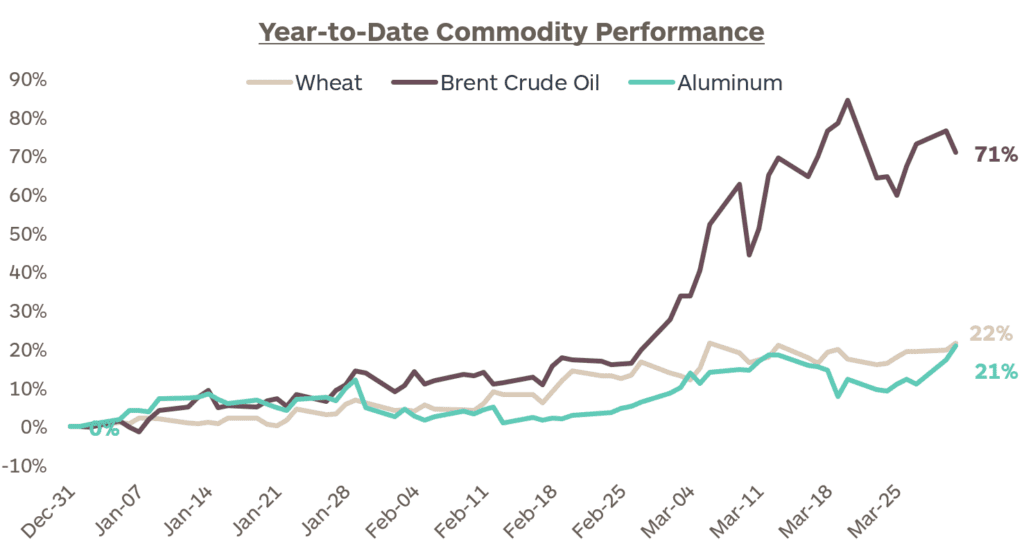
Source: Chicago (CBOT) Wheat (continuous contract price), Brent Crude Continuous on ICE Futures Europe ($ per barrel), Aluminum on London Metal Exchange (Cash, USD per metric ton) through 3/31/2026. FactSet, Cerity Partners
The United States entered the year with one of the stronger forecasted economic growth rates of any country, although the government shutdown and the slowdown in labor force growth due to restricted immigration were two headwinds expected to slow first-quarter growth. Adding higher energy prices as an additional headwind in the final month has brought estimates of first-quarter 2026 growth from 3.0% at the beginning of the year to 2.0% as the quarter was ending. While this level of growth is close to the long-term trend US growth rate, continued high (or perhaps even higher) energy prices will offset any benefit expected from the 2025 tax act. What remains an important driver of US growth is the secular advance in corporate spending on AI capabilities, which will keep capital spending on a rather healthy growth path. If energy prices stay high, an additional driver of corporate capital expenditures could be greater spending in the energy sector. Trade should contribute positively to GDP growth in the coming quarters, as price inflation due to tariffs slows imports and exports increase to address growing global energy access concerns.
Higher energy and food prices due to supply constraints emanating from the Iranian conflict will slow consumer spending, although consumption in the United States has recently exhibited a “K” pattern, with the higher-income tiers continuing to spend at higher rates due to the wealth effect of appreciating security and real estate prices while the lower-income cohorts have struggled with stagnant job and wage growth. The large swath of recent retirees has been somewhat of an economic wildcard in their willingness to draw down on savings and spend at a rate more predicated by their age than the state of the economy. Food and energy inflation may not deter these more demographically driven spending habits, but any decline in their securities portfolio may cause some hesitation.
European economies were expected to grow coming into 2026 but at rather anemic rates backed by expansionary monetary policy and the increased willingness of the traditionally austere Germans to engage in greater deficit spending on defense capabilities. Due to Europe’s geographic proximity and historic reliance on imported energy, particularly natural gas, an extended duration of the Iranian conflict can easily cause the economies of the continent and the UK to decline over the coming quarters. Higher US tariffs and greater Chinese competition are additional constraining factors in their export industries. Already high fiscal deficits outside of Germany will limit government support, and the central banks are now considering tightening policy to fight inflation, which can further slow aggregate demand. The European economies can likely withstand the level to which energy prices rose at the end of the first quarter, but any meaningful increase from those levels will likely lead to recession.
Japan appeared poised to break out into a higher growth trajectory on the back of fiscal stimulus from its new administration, some real wage growth, and capital spending on AI applications. Rising energy prices and the potential for shortages will slow that growth but should not lead to recession given these underlying growth pillars. Meanwhile, the Chinese government is beginning to concede that 5% GDP growth may no longer be realistic, although the government has impressively been able to compensate for the slowdown in exports to the United States with greater export growth among its Asian neighbors. Consumer spending continues to frustrate the government’s economic planners, as lower property values and weak demographics restrain the growth rate. Fiscal policy initiatives have been put in place primarily to spur consumption and prevent the development of a deflationary cycle that can occur should production grow faster than demand. Monetary policy support is more questionable as the authorities remain worried about capital flight out of the country.
Monetary policy
The outbreak of hostilities in Iran and the resulting spike in energy prices may be forcing the Fed to quickly shift back to inflation fighting as its primary objective. Employment growth may be slowing, but the unemployment rate remains near historic lows. Unless the Iranian conflict ends early in the second quarter, further federal funds rate cuts are likely off the table for the rest of the year, as inflation forecasts are rising due to supply pressures not only in energy but also in the broader commodities complex. The Fed is not yet seriously discussing tightening policy, and the ascension of Kevin Warsh as the incoming Fed chair should turn the group incrementally more dovish, but investors should prepare for the possibility of rate increases should energy prices increase further from current levels. Any rate increase that addresses supply-constraint inflation would likely lead to notably slower economic growth.
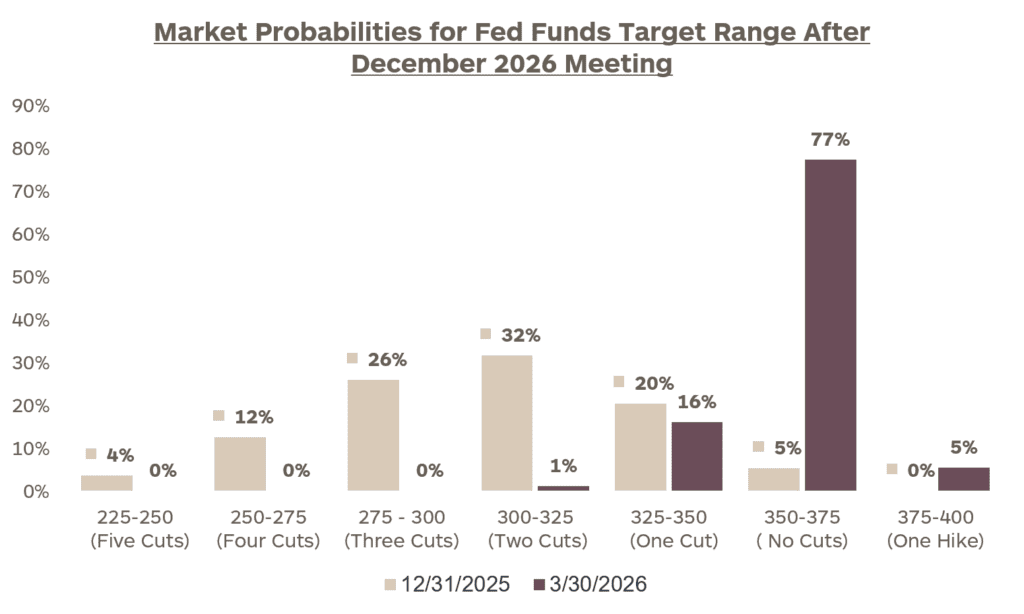
Source: CME FedWatch, as of 3/30/2026; Cerity Partners
The single-mandate European Central Bank (ECB) is already stirring with discussion around rate increases in response to commodity inflation. With Brent crude oil and natural gas prices rising at higher levels than seen in the United States, markets are pricing in two 25-basis-point rate increases over the coming months. These moves would be contingent upon energy and other commodity prices continuing to rise as supply is further restrained due to the Iranian conflict. Policymakers at the Bank of England are confronted with a similar dilemma, although the British central bank is currently much more restrictive than its continental counterparts with a policy rate of 3.75% compared to 2.00% at the ECB. This may allow them more time to “wait and see,” as Governor Andrew Bailey put it during the March policy meeting.
As has been the case for decades, the Bank of Japan has been trapped in an excessive ease posture from which it has been trying to escape under the leadership of Governor Kazuo Ueda. Rates have finally moved out of negative territory, and the balance sheet holdings of equities and real estate investment trusts are beginning to be reduced. However, Japan’s new Prime Minister Sanae Takaichi is a proponent of liberal fiscal and monetary policy to awake the demographically challenged domestic economy from its doldrums. So, what should be an intuitively natural bias toward raising rates to address above-target inflation is now not so obvious.
In contrast, China is relatively insulated from energy price increases as it has aggressively built energy stockpiles. It has also greatly developed its alternative energy industries, so there will be less pressure on the People’s Bank of China to tighten policy. The central bank may actually welcome some inflationary pressures as the economy has fallen into deflation.
Bond markets
The global bond market reaction to higher energy and commodity prices has been interesting and largely reflective of the first stage economic impact of the Iranian conflict. Because the global economy was generally growing near trend coming into the year, the initial concern of bond investors has been the inflationary implications, as reflected in upward shifts of most global yield curves. The more debt-laden countries have seen the largest increases in intermediate-to-long-maturity yields as the prospect of greater transfer payments and a higher level of defense spending can enlarge already bloated budgets.
The US Treasury yield curve is now fully upward sloping and shifted notably higher during the last month of the quarter. Additionally, the curve exhibited some distinctive flattening, which is likely predictive of the second stage of a protracted move higher in commodity prices. Tighter monetary policy reflected in the shorter end of the curve will eventually cause a slowdown in economic growth and in a worst-case scenario a recession whose early signal could be an inversion of the curve. This is not yet a base case forecast at current energy price levels, but it is a development worth monitoring carefully.
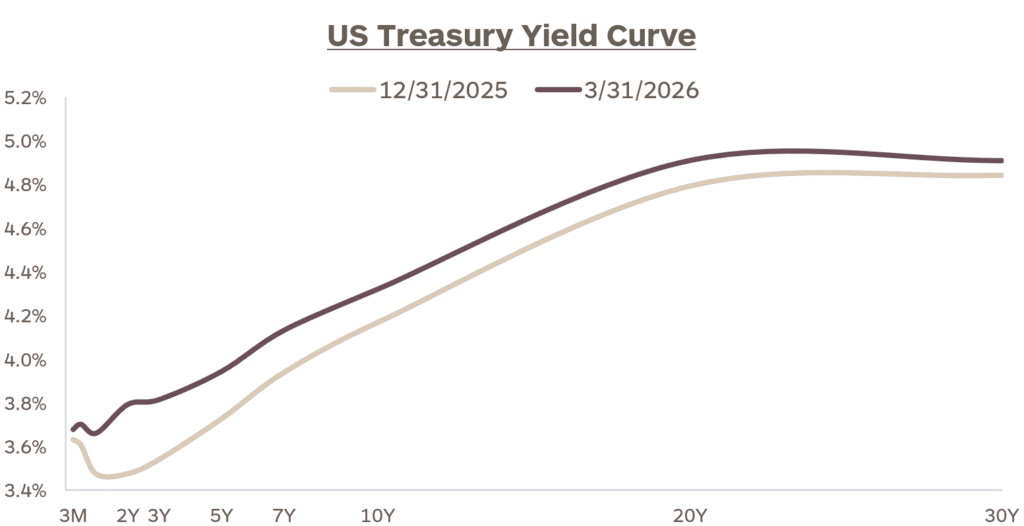
Source: FactSet, Cerity Partners
Another interesting signal provided by the bond market is the evolution of credit spreads since hostilities broke out at the end of February. There has been some spread widening in both the investment-grade and high-yield sectors to reflect the initial economic dampening effect of higher energy prices. But this was from historically tight levels, and at current levels, spreads remain near their historic lows. High-yield bonds are likely fairly valued to slightly expensive. Private debt has dominated the headlines in the first part of the year mainly due to sectoral issues within their software holdings. While there may be some markdowns and higher default activity within this sector, the remaining sectors in both the public and private debt space appear sound.
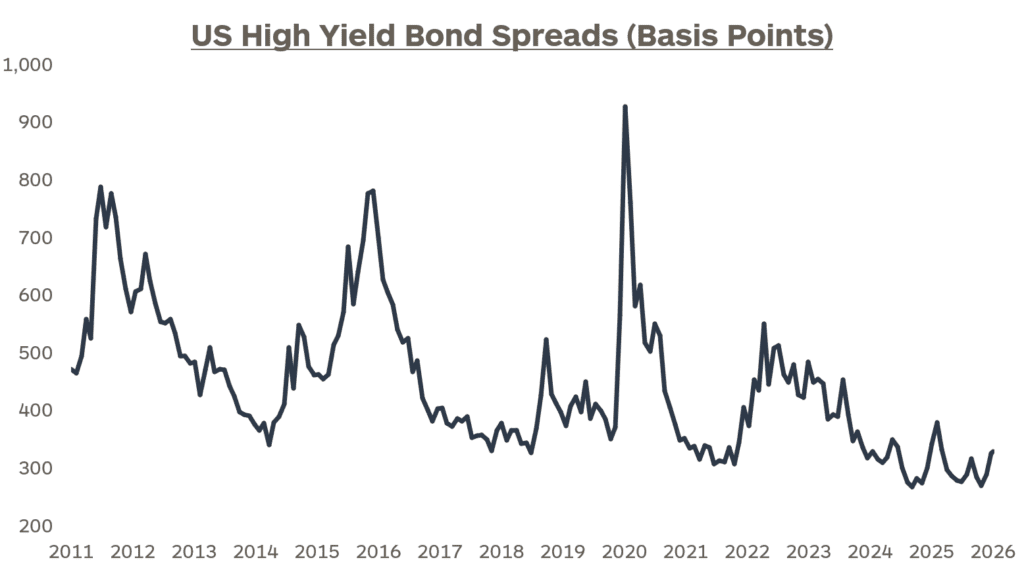
Source: ICE BofA US High Yield Option-Adjusted Spread through 3/31/2026. FactSet, Cerity Partners
Less available new supply to absorb and historically better credit underwriting standards led to notable outperformance of municipal bonds against their taxable counterparts during the first quarter. This relative performance dynamic is likely to continue if energy prices begin to cause a more pronounced economic slowdown.
Equity markets
Earnings growth is expected to be the predominant driver of US equities in 2026, as valuation multiples appeared stretched coming into the year. First-quarter earnings for S&P 500 companies are expected to grow by 13% year over year. It will be the fifth consecutive quarter of double-digit earnings growth. The information technology sector will account for the bulk of this growth, with earnings expected to be 45% higher as the dramatic innovations in AI continue to be monetized and deliver sharply higher revenues. Unfortunately, higher interest rates across the yield curve plus a greater premium demanded by investors due to heightened geopolitical risk have combined to cause a decrease in valuation multiples, which led to the declines seen during the quarter.
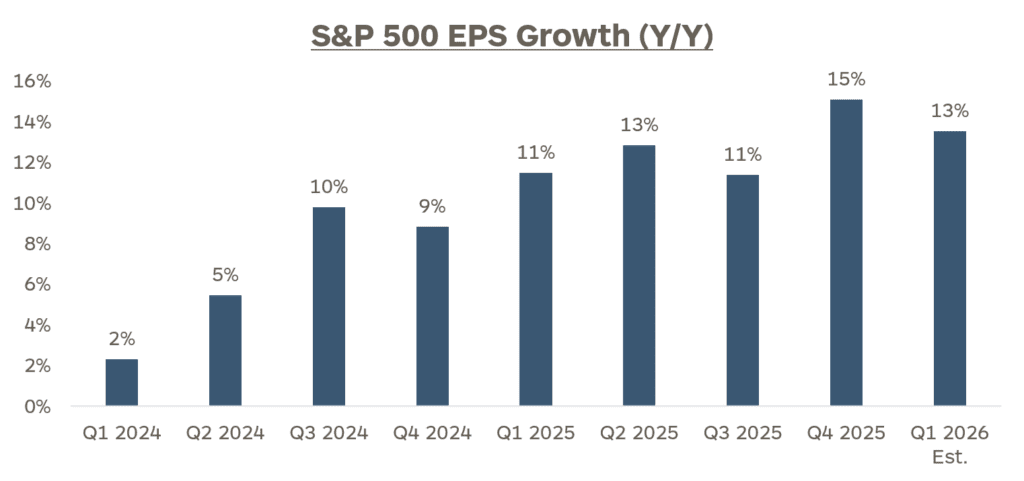
Source: FactSet, as of 4/1/2026; Cerity Partners
Moving into the second quarter and remainder of the year, a continuation of hostilities that drive energy prices even higher would begin to pressure profit margins as well as top-line revenue in the more cyclical sectors of the market. In addition to energy cost increases, a shortage of helium due to transportation bottlenecks is threatening semiconductor chip supply and may at least temporarily disrupt the powerful secular AI investment theme. A quicker resolution will not cause a complete reversion back to the prior state as some long-term effects will be felt throughout the commodities complex, but earnings can again be the focus, and equities should experience a strong rebound.
Within the US equity market, an impressive breadth of participation at the back end of 2025 into the first couple of months of this year helped reduce some of the criticism that market performance had been so top-heavy and dominated by only a few names in the technology and communication services sectors. Should higher commodity prices slow the economy and impact margins, this favorable development is at risk, as there would again be a premium on companies and sectors that could still generate growth.
European and Japanese equity markets tend to be more cyclically exposed than the US large-cap markets, so a protracted conflict that slows growth or turns the various economies into recession will undo the relative performance progress investors finally began to see in 2025. Valuation in these markets remains relatively inexpensive and should again attract investor interest if the conflict were to end early in the quarter with little additional damage to the global energy infrastructure. The rise in energy and other commodity prices created a distinct bifurcation within the relative performance of emerging market equities. Commodity-producing Latin American country markets have generated positive performance through the first quarter, but the commodity-consuming Asia country markets that rely so much on imports from the Middle East have been particularly hard-hit and would be the primary beneficiaries of the end of hostilities and the resumption of free-flowing oil and natural gas.
Commodities and currencies
Oil moved from an oversupplied commodity to a shortage dynamic literally overnight back in late February as the US-Israeli joint operation in Iran caused damage to important energy infrastructure and an effective shutdown of cargo transportation through the Strait of Hormuz. It is difficult to determine when the transportation bottlenecks end, but some of the production damage will take years to rebuild. US production will meet some of the demand, but even in a best-case scenario, oil prices should remain meaningfully above the levels prevalent before the conflict. Of course, they could go even higher as Middle East production facilities become more inviting targets.
We saw through the month of March that central banks around the world are not merely one-way accumulators of gold as monetary reserves. When needed, the gold is sold to fund various initiatives and budget shortfalls. In this geopolitically charged environment where global central bankers appear biased toward monetary ease, gold should continue to be a viable alternative store of value as individuals and institutions address the decline in the value of most global fiat currencies. Fundamentally though, the near-term tightening bias being put forth by several global central banks may be somewhat of a headwind to appreciation this quarter.
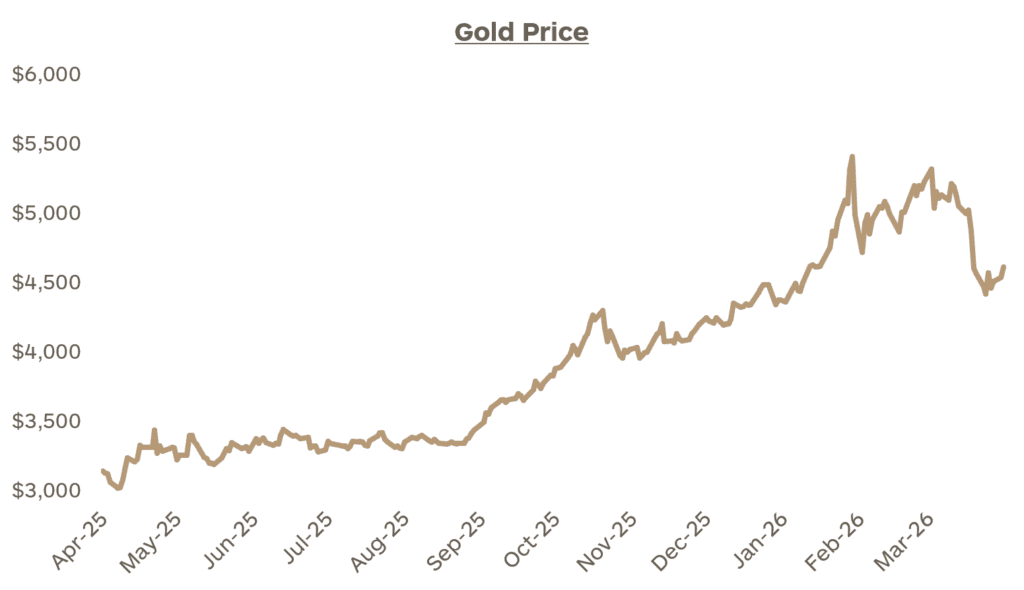
Source: LBMA Gold Price PM Index through 3/31/2026. FactSet, Cerity Partners
Geopolitical instability tends to increase the demand for safe-haven assets, and despite some growing talk that the US dollar may have seen better days, it remains a reliable port in the storm as it has appreciated roughly 3% since the beginning of the Iranian conflict. Relative economic growth rates and relative interest rates still favor the dollar against most other global currencies, but the expected dovish leaning of the Fed under a new chair may exert renewed selling pressure once the conflict in Iran ends.
Please read important disclosures here.