
Foundations and endowments operate in an environment where portfolio performance directly impacts grantmaking and operations. As these fiduciary responsibilities grow more complex, many institutions look to an Outsourced Chief Investment Officer (OCIO) partner for additional investment expertise. However, we believe a truly effective OCIO partnership extends far beyond the investment effort. By providing robust governance, education, and strategic planning support, an OCIO can empower leadership to focus on their highest-use initiative: advancing the long-term mission and sustaining it for future generations.
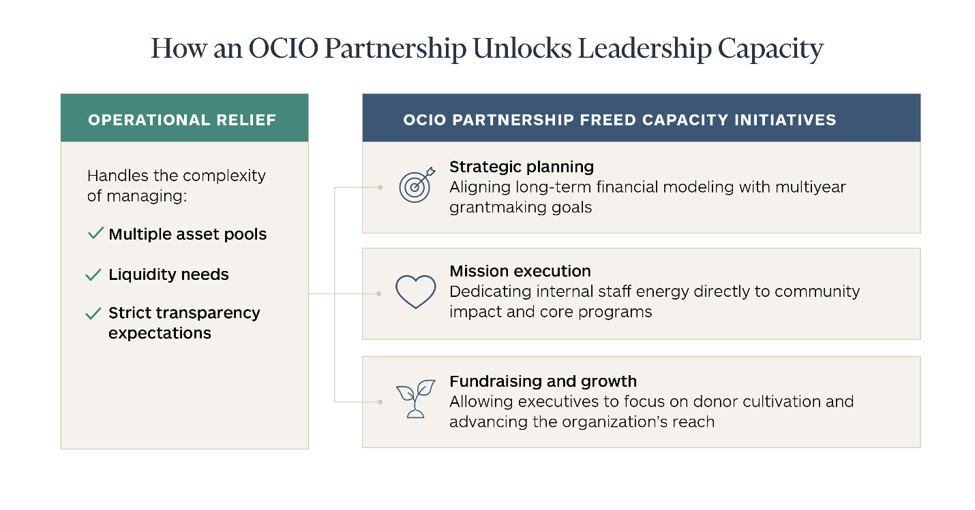
When seeking an OCIO, mission-driven institutions can maximize value by looking for a partner that not only provides services directly related to investment management but also supports constituent education, strategic financial planning, and stakeholder communication.
How an OCIO solves complex operational challenges
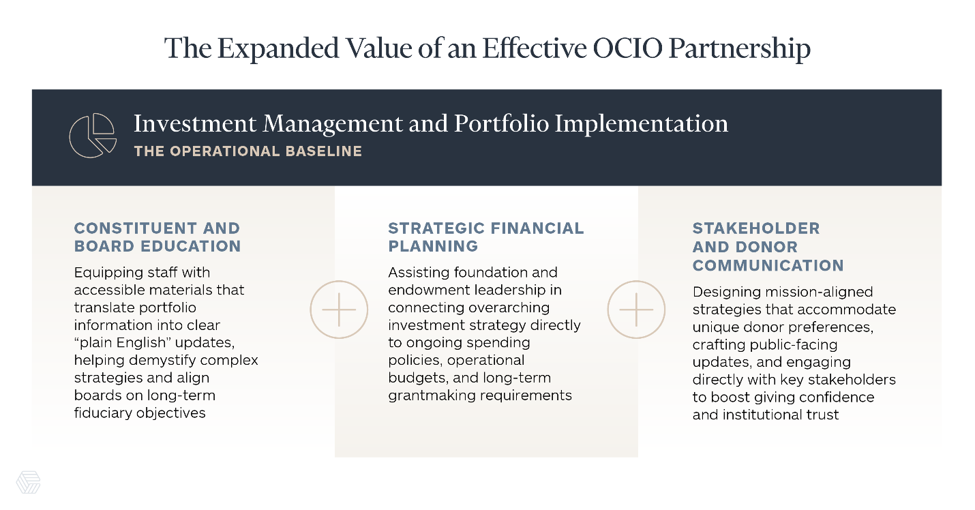
Managing multiple asset pools with distinct liquidity needs and strict transparency expectations creates heavy operational complexity for nonprofits. A comprehensive OCIO partner steps in to help handle these administrative and fiduciary burdens, extending far beyond asset management.
By taking on these resource-draining tasks, an OCIO provides specialized support that frees up foundation and endowment leadership to focus on their highest-value initiatives, such as strategic planning, mission execution, and fundraising and growth.
Education and governance support
Foundations, endowments, and other mission-driven institutions typically rely on volunteer board and committee members who bring diverse expertise. While some trustees may have deep financial backgrounds, others may not be as close to the nuances of institutional investing—making consistent education and alignment crucial.
High public and stakeholder scrutiny means committee members must clearly understand what the organization owns and why. The same expectation applies to internal leadership, including CEOs, CFOs, and advancement officers, who must be well-versed in matters related to the portfolio in addition to managing their core responsibilities.
Effective OCIOs often offer tailored training on topics such as fiduciary roles, investment policy, risk management, and the criteria for selecting investment managers. They provide regular market updates and thematic deep dives on public markets, alternatives, and mission-aligned investing to help staff and board members interpret risk, market activity, and liquidity coverage.
Investment committees may meet only a few times per year. That’s why an OCIO should translate daily portfolio stewardship into digestible insights, reducing staff and volunteer mental load while empowering them with the information they need.
Strategic financial planning
Foundations, endowments, and other mission-driven institutions must balance long-term portfolio growth with spending needs that can change over time. Liquidity planning can be affected by factors within and outside the institution’s control, including unpredictable donor activity and market conditions. As a result, investment committees must frequently consider questions like:
- How much liquidity do we need in the short and medium term?
- Are we prepared to navigate a market downturn?
- What if giving decreases at the same time as grantmaking needs increase?
The most sophisticated OCIOs are built to navigate these types of questions and can integrate them into asset allocation policy, portfolio construction, risk management, and operations. Customizing investment pools based on liquidity needs helps ensure that institutions have what they need when they need it.
Integrating enterprise finance and portfolio strategy
An effective OCIO partnership does not look at the investment portfolio in a vacuum. True “beyond the portfolio” support begins by thoroughly analyzing your organization’s broader balance sheet and cash flow constraints, such as operational liquidity demands, debt liabilities, and capital project budgets, and then structuring the portfolio directly to solve for those enterprise needs.
To facilitate this deeper strategic alignment, a well-resourced OCIO works hand in hand with internal finance staff to provide that may include:
- Enterprise liquidity and budget modeling: Stress-testing cash flows to ensure the portfolio optimally supports multiyear budget planning, audit requirements, and grantmaking targets.
- Comprehensive balance sheet analysis: Evaluating external assets and liabilities, including real estate holdings and debt structures, even if they fall outside the core investment mandate.
- Operational ecosystem support: Assisting with vendor onboarding and optimization – from streamlining custodian selection to supporting the audit preparation process – easing the administrative burden on your internal finance team.
Stakeholder and donor engagement
Education extends beyond internal staff and Board members. Stakeholder and donor engagement can help ensure investment decisions and the portfolio management effort are effectively communicated to the people connected to an organization’s mission.
For many mission-driven institutions, stakeholders expect transparency on portfolio performance and impact. Donors frequently look for institutional alignment between an organization’s mission and its investment strategy. An OCIO assists in translating these values into tangible portfolio constraints, such as utilizing environmental, social, and governance (ESG) criteria or prioritizing local community development investments. This strategic alignment can serve as a strong signal of institutional integrity, boosting donor confidence and reinforcing the nonprofit’s core values.
OCIOs can equip staff with accessible materials that turn portfolio information into “plain English” updates. They may also design mission-aligned strategies that accommodate donor preferences while remaining within the approved investment policy. They can also help foundation and endowment leadership craft public-facing communications when investment topics require a clear institutional response.
OCIOs go beyond providing information to board members or staff by engaging directly with key stakeholders and donors when appropriate. This active participation helps demystify complex portfolio strategies and instills deep institutional confidence in the investment program. For a community foundation facing divestment inquiries, for example, an OCIO can shed light on actual divestment movements within the portfolio. This level of support can deepen trust and may inspire additional giving.
Expect more from an OCIO relationship
The right OCIO partner can often offer far more than investment management. When selected thoughtfully, an OCIO can add meaningful value at the institutional level, helping leaders connect investment strategy to the organization’s ongoing responsibilities and long-term mission.
Cerity Partners OCIO is a boutique firm offering customized Outsourced Chief Investment Officer solutions to endowments, foundations, and family offices. We have significant experience partnering with mission-driven organizations for over 15 years. Learn more about how our solutions can help you.
Cerity Partners LLC (“Cerity Partners”) is an SEC-registered investment adviser with office locations throughout the United States. Registration of an Investment Advisor does not imply any level of skill or training. OCIO assets are managed by Cerity Partners OCIO LLC (“Cerity Partners OCIO”), a wholly owned subsidiary of Cerity Partners.
The information presented is limited to general information pertaining to Cerity Partners’ services, views, outlooks, and opinions and is for informational purposes only. Information is presented for illustrative purposes only and does not constitute an exhaustive explanation of relevant considerations when evaluating an OCIO provider. The information contained herein should not be construed as investment, tax, legal or fiduciary advice. There is no guarantee that the views and opinions expressed will come to pass. Before making any decision or taking any action that may affect your finances or your company’s finances, you should consult a qualified professional adviser. The information presented is subject to change without notice and is deemed reliable but is not guaranteed.
Investing involves risk, including the possible loss of principal and fluctuation of value. There is no assurance objectives will be met. Alternative investments can be speculative and may not be suitable for all investors.
Certain information is based on or derived from independent third-party sources that, in certain cases, may not have been updated through the date of this information. While such information is believed to be reliable for the purposes used herein, Cerity Partners has not independently verified the assumptions on which such information is based nor assumes any responsibility for the accuracy or completeness of such information.
©2026 Cerity Partners LLC. All Rights Reserved.
Please read important disclosures here.