

Download this week’s full edition!
Surging gas prices drove a hot CPI print, and while the downstream economic impacts of inflation—from shipping to airfare—are mounting, offsetting factors like strong employment and higher tax refunds may help cushion consumers.
What caught our eyes this week
Pain at the pump
As expected, we got a hot CPI print, with headline inflation up 0.9% on the back of a 21% monthly increase in gasoline. This figure incorporates some, but not all, of the spike in prices we’ve seen so far, up to a $4.13 national average as of Monday, April 13. Unless things reverse quickly (unlikely), we could see another rough print for April, with gas alone contributing near 1% to a year-over-year headline figure close to 4%. The big macro question is how consumers will react to this kind of sticker shock at the pump. If we hold their behavior constant, an increase to $4 per gallon would require roughly $700 more in annual spending on gas per household, or about $100 billion nationally, which in a vacuum would mean $100 billion less in spending on everything else. That alone, in the context of $21 trillion of total consumption, is not likely to move the needle. But it’s not alone: Other downstream impacts from the war, like higher airfare, costs for shipping and raw materials, and any potential shortages, will also be factors. Fortunately, there are some offsets, with higher tax refunds from last year’s tax bill providing a timely cushion to a population that is largely still employed and enjoying decent—albeit slowing—wage growth.
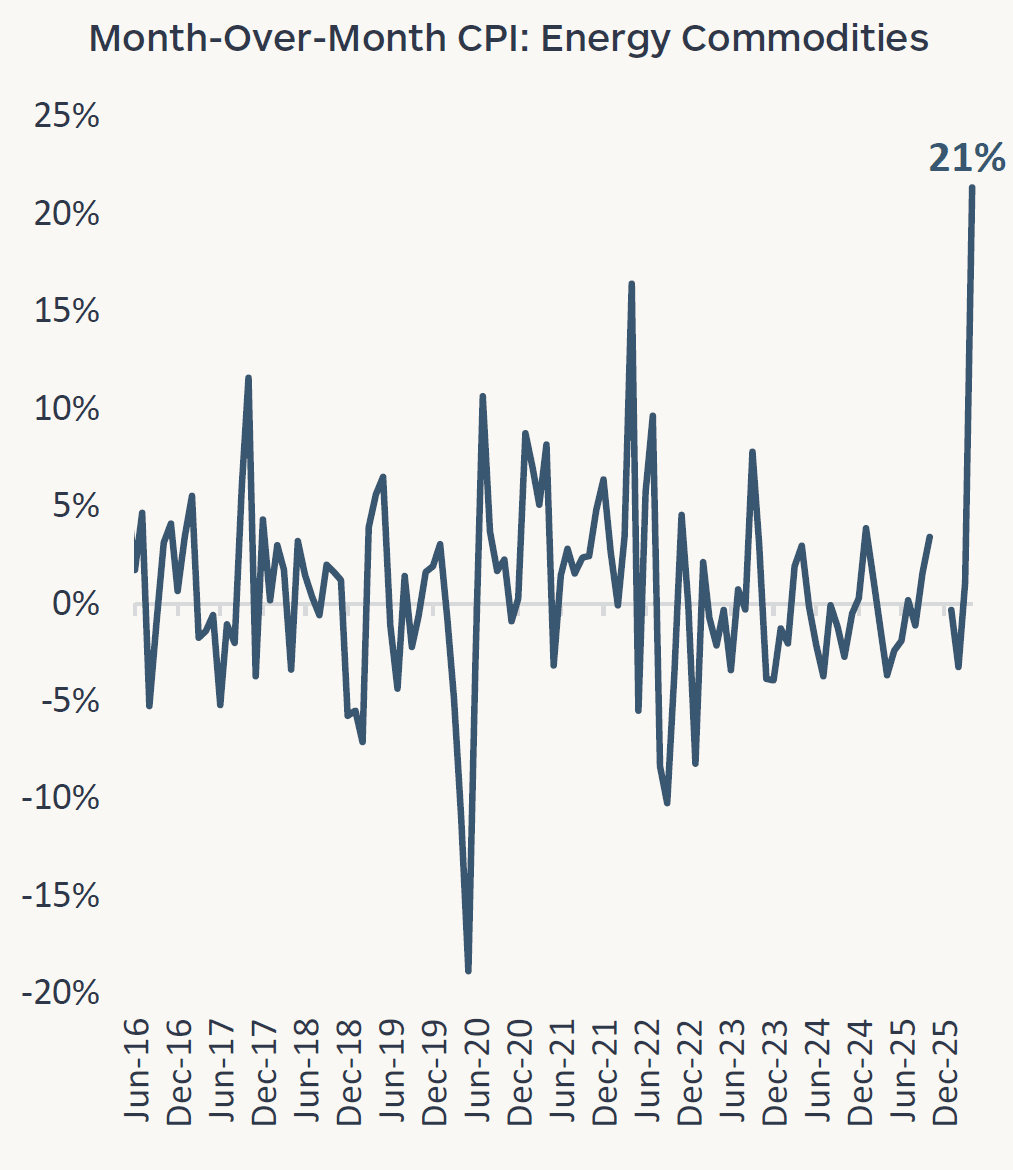
CHART OF THE WEEK: Cerity Partners, FactSet, Bureau of Labor Statistics, as of March 2026.
Past performance does not guarantee future results.
Please read important disclosures here.