

Download this week’s full edition!
Once SpaceX goes public at a $1.77 trillion valuation, most major indexes will fast-track its inclusion and it’s expected to eventually become a top 15 holding as more shares are unlocked over time—though the S&P 500 will be a notable exception for at least a year.
What caught our eyes this week
To the moon (or Mars)?
Buckle up and get ready for liftoff: SpaceX is set to go public this Friday, raising a record-shattering $75 billion at a $1.77 trillion valuation. Major index providers are grappling with how to handle a company making its public market debut at such a size.
Nasdaq, Russell, MSCI, and CRSP have all adopted fast-track processes to usher SpaceX (and, presumably, Anthropic and OpenAI) into their respective indexes as soon as five to 15 trading days after listing. Most take a “float-adjusted” approach to weighting, which uses the $75 billion initial float (which will ramp up over the first six months), rather than the overall market capitalization, meaning SPCX will be a relatively small position in most indexes at first. Nasdaq is an outlier with its three-times float methodology. As more shares are unlocked, we expect SPCX to eventually become a top 15 name in many indexes depending on how it trades. Interestingly, S&P Dow Jones held firm on 12-month seasoning and profitability requirements for its flagship S&P 500 index, delaying inclusion by at least a year (and potentially more, given SpaceX’s present lack of profitability—a problem also faced by Tesla back in the day). Even without the S&P 500, index funds are expected to contribute billions in mechanical demand in the early days of trading.
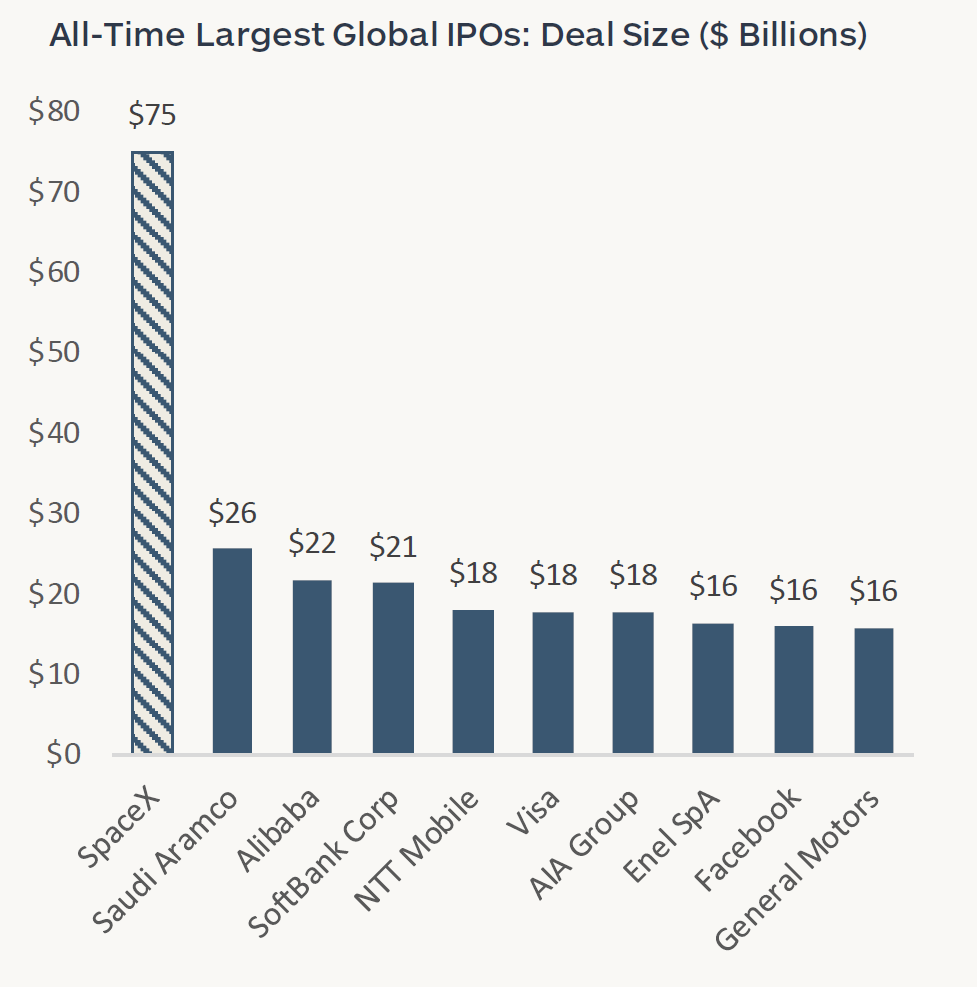
CHART OF THE WEEK: Cerity Partners, Renaissance Capital, SPCX IPO size is estimated as of 6/8/2026
Past performance does not guarantee future results.
Please read important disclosures here.