

Q2 2026 in review
If the first quarter of 2026 was defined by the sudden onset of war in the Middle East, the second quarter was defined by a convoluted—and often confusing—attempt to end it. At the start of the second quarter, the world was four weeks into a violent conflict that seemed to escalate by the day. Traffic through the Strait of Hormuz, a crucial oil choke point, had grounded to a halt, opening a historic supply gap that quickly drove oil prices well north of $100 per barrel, with some market observers questioning whether $200 was next. By the end of the quarter, we had a shaky but intact ceasefire and a signed “Memorandum of Understanding” laying out a path to a negotiated deal between the United States and Iran. This fragile new equilibrium still offers as many questions as answers, but it’s been enough to send oil prices all the way back to $70 per barrel—effectively a round trip from the start of the conflict just four months ago. With the ceasefire in place, traffic through the strait began a tepid creep back toward normal, reaching roughly half of prewar volumes by the end of June.
Avoiding worst-case scenarios for oil prices came down to an impressive display of flexibility from energy markets. Neighboring countries quickly ramped up pipeline activity, diverting up to five million barrels per day out to the Red Sea and Gulf of Oman. Commercial and strategic inventories, which had been close to full heading into the conflict (the US Strategic Petroleum Reserve being the glaring exception), were drawn down aggressively. China, a heavyweight on the demand side, cut its own imports sharply—by about half between February and June. Exactly how the country did this remains somewhat unclear, but the result was 5 million barrels per day of supply added back to global markets—on its own making up a quarter of the 20-million-barrel supply hole the closure had blown in the market.
The US economy proved more resilient through the energy shock than many had feared. After growing at a 2% annual rate in the first quarter, the economy looks on track to deliver more trend-like growth in the second, with the Atlanta Fed’s GDPNow estimate currently at 2.5%. That resilience continues to be led by strength in business investment—more specifically, equipment and intellectual property tied to the ongoing artificial intelligence (AI) build-out, which by itself accounted for over half of first-quarter gross domestic product (GDP) growth. The labor market also held up well and appears to be reaccelerating. Three employment reports averaging 188,000 new jobs a month, with the unemployment rate steady at 4.3%, have assuaged fears that last year’s stagnation would turn to outright deterioration.
For most Americans, the primary impact of the war back home is being felt through the price channel. The headline Consumer Price Index (CPI) jumped to 4.2% year over year in May, the fastest pace in three years and a sharp move up from January’s 2.4%. Nearly all of the spike has been driven by energy, with gasoline prices up 41% year over year in May. Outside of energy, inflation trends remained relatively mild, with core CPI, which strips out food and energy, holding at 2.9%. Core goods prices fell in May for the first time in over a year, evidence that any tariff-driven goods pressure from earlier in the cycle was fading.
A challenging inflation backdrop set the stage for a leadership change at the Federal Reserve (Fed). Jerome Powell’s term as chair ended on May 15, and Kevin Warsh was sworn in as the Fed’s 17th chair on May 22. At his first meeting and press conference, Warsh announced no change in policy but struck a hawkish tone, repeating the truncated statement’s last line several times: “The Committee will deliver on price stability.” Priced for multiple rate cuts as recently as March, federal funds futures have flipped, now pricing in no chance at all of a cut in 2026, a 17% chance the Fed holds steady, and an 83% chance of one or more rate hikes.
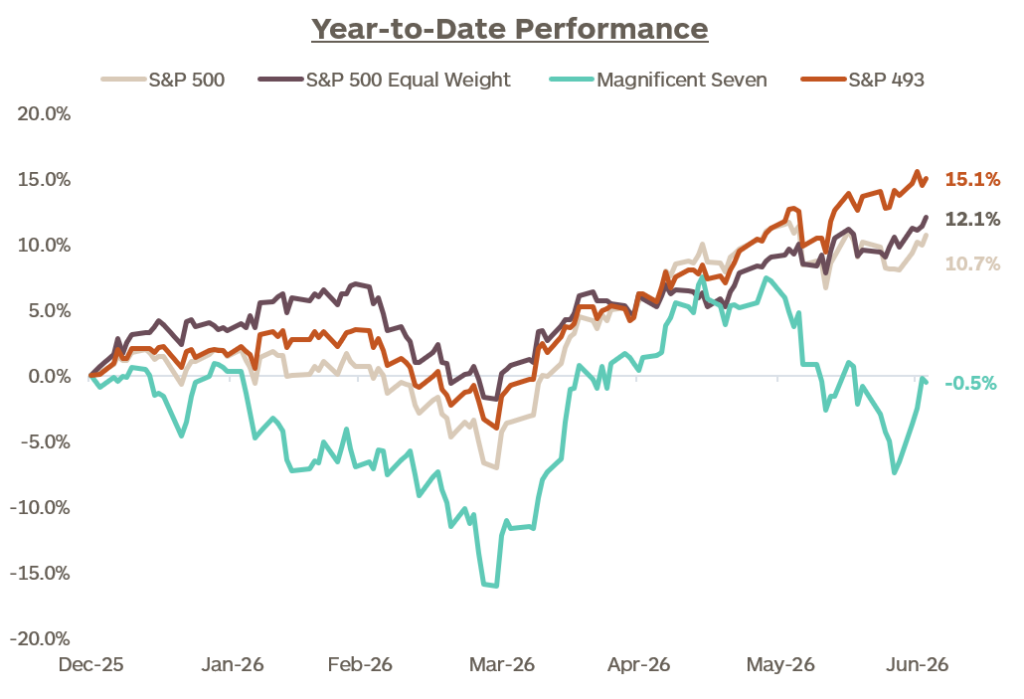
As for equity markets, what a difference three months can make! Through all the noise and uncertainty, the S&P 500 came roaring back from its first-quarter sell-off, gaining 15% for its best quarterly return in six years. Supporting the rally was a blockbuster first-quarter earnings season, with S&P 500 earnings growing 29% year over year, the highest growth rate in nearly five years. Analysts are now also projecting 20% plus growth for the next three consecutive quarters.
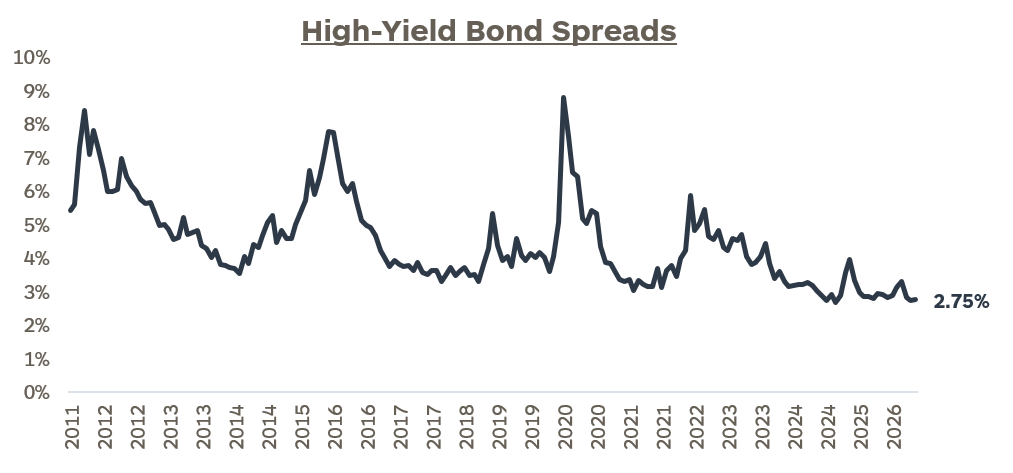
The US Treasury curve flattened over the quarter as short rates rose in anticipation of hikes, while long rates oscillated within recent ranges before settling to end the quarter near where they began. Credit spreads for investment and non-investment-grade bonds compressed over the quarter, ending near multidecade lows.
The US dollar continued to find its footing after a bout of weakness in 2025, thanks to the shift in investor expectations toward rate hikes, along with our economy’s relative insulation from Middle East energy shocks and the continued attractiveness of US equity fundamentals. The US Dollar Index climbed to a one-year high of 101, about 5% above its January low.
Our outlook for the year
Global economy
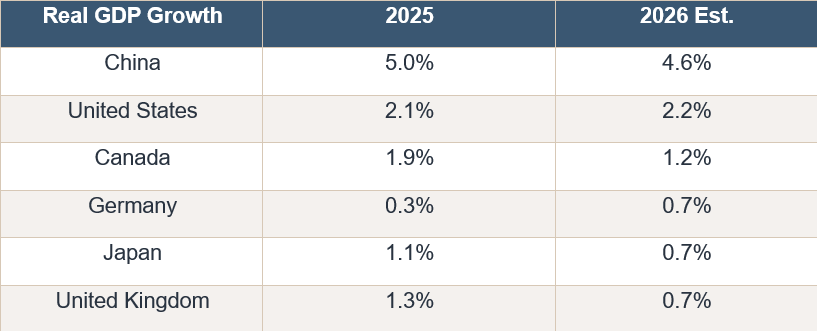
As we move into the second half of the year, the apparent end of the Iranian war allows investors to concentrate on economic and earnings fundamentals as the major drivers of further equity market advances. The US economy has arguably been driven by the AI capital spending cycle, although it could never grow at its current trend rate of 2.0% without a reasonably strong consumer. Consumer spending remained generally solid in the first half of the year despite the sharp spike in energy and other commodity prices. The wealth effect of higher stock and real estate prices helped drive spending in the upper-income cohorts of the population, but solid jobs and wage growth, which comprise the income effect on spending, certainly contributed as well. An additional catalyst has been the propensity of recent retirees to tap their large accumulated savings in order to spend at rates close to those achieved during their working years.
Source: FactSet, estimates as of 7/2/2026
Job growth is expected to remain comfortably positive for the remainder of this year and into 2027, and wage growth should follow given the strong corporate earnings environment. It may be a little early but watch for tangible productivity benefits from the massive AI investments and broad utilization of AI software applications across market sectors that should keep unit labor costs relatively low. Relief from high energy prices is another factor that is likely to drive consumer resilience over the remainder of the year. Capital spending on technology products should continue to be the most important driver of growth over the next 12 months, as we still appear to be in middle innings of the powerful AI adoption theme. Accelerated depreciation features in last year’s One Big Beautiful Bill Act should help encourage capital spending in sectors outside the technology space. Residential housing continues to struggle with affordability issues but should not detract much from growth in the second half of the year. Any potential detraction may be offset by a better trade position as imports fall due to tariffs, an appreciating US dollar, and increased domestic competition.
Lower energy prices stand to benefit European economies as most are energy importers. Declining energy costs may also keep central banks at bay, as the policy forecast quickly turned from an expectation of continued ease going into the year to tightening once oil supply was unable to navigate through the Strait of Hormuz. Despite large budget deficits, which tie the hands of most of the continent’s finance leaders, fiscal policy is likely to be modestly expansionary as historically austere Germany is allowing its deficit to enlarge through higher defense and infrastructure spending. GDP growth in Europe should come in around 1.0% over the next 12 months, with businesses remaining cautious around capital spending as competition intensifies with both China and the United States.
The recently elected and inducted administration in Japan is biased toward loose fiscal policy to achieve a 1.0% real GDP growth rate. Spending on infrastructure and increased support of its technology industries are the primary initiatives, although it is unlikely the GDP growth target will be reached in 2026. The economy should not fall into recession, but a weak Japanese yen will tax consumers while the remnants of commodity price inflation will further slow the demographically challenged Japanese consumer.
It is likely unrealistic for China to target 5% GDP growth, as the poor population demographics combine with some misplaced government incentives to constrain the economy. China should be able to achieve 4.5% growth this year on the back of a strong technology industry and fierce fiscal policy support of its so-called industry champions. Consumer spending will remain constrained due to the extended property recession that has sapped confidence within the domestic economy. Exports to the United States may be constrained by tariffs and entrenched trade friction, but the government has been able to effectively replace lost US exports with sales to other regions.
Monetary policy
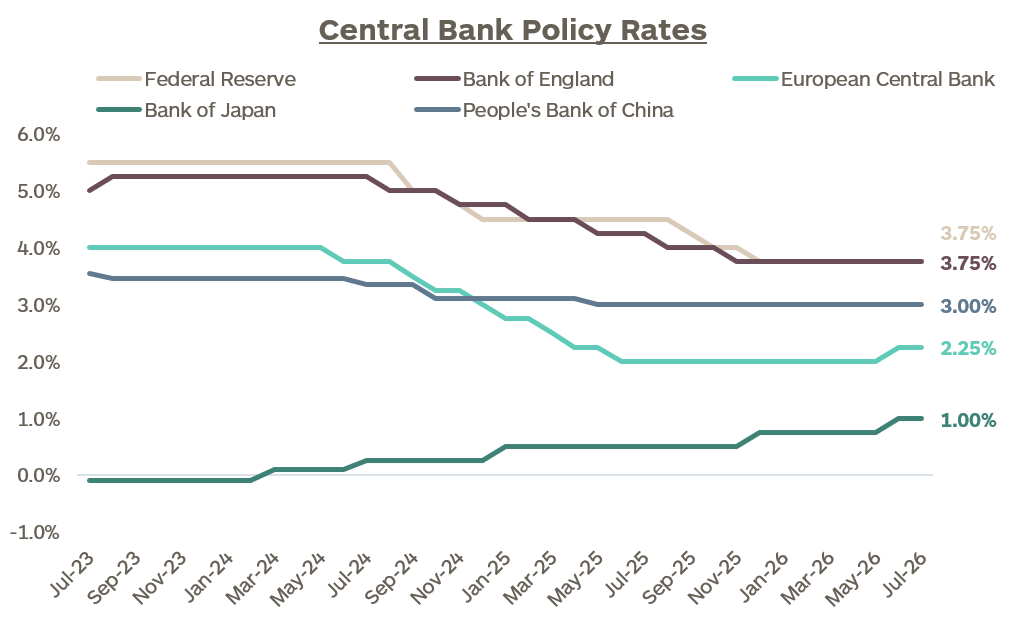
After overseeing the decision to hold the federal funds rate steady at his first meeting as Fed chair, Kevin Warsh surprised investors somewhat by strongly stating that the Fed under his leadership will achieve price stability. Given the inflation rate is meaningfully higher than the 2% target and the maximum employment mandate has largely been achieved, inflation is the problem the Fed needs to currently confront. The second quarter ended with investors believing the Warsh-led Fed had pivoted incrementally hawkish with probability of a rate hike before year-end at close to 85%. The subsequent decline in oil prices may have reduced the immediate pressure to increase rates and may buy some time to demonstrate the productivity benefits of AI on unit labor costs. No change in the federal funds rate for all of 2026 is somewhat of an outlier prediction, but it is the most likely outcome given the expectation that inflation peaked in May and will likely resume its downward trend toward the 2% target over the coming months.
Source: YCharts, Cerity Partners
Like the Fed, the Bank of England refrained from tightening at its June meeting despite its single price-stability mandate. It cited the end-of-quarter fall in energy prices and overall weakness in demand as rationale for holding its policy rate at the 3.75% level. Starting from a much lower absolute level of policy rate than the Fed or the Bank of England, the European Central Bank (ECB) moved to a tightening stance in its June meeting. With a potential stagflation problem possibly averted by the post-meeting decline in energy prices, the June rate increase may be the only one necessary. ECB President Christine Lagarde is worried about second-round effects of higher energy prices, but the lack of an apparent wage-price spiral should be the key element allowing inflation to return to pre–Iran war levels.
Governor Kazuo Ueda at the Bank of Japan (BOJ) is in a difficult position as he would love to continue normalizing interest rates after decades at zero. However, freshly minted and exceedingly popular Prime Minister Sanae Takaichi is asking for continued loose monetary policy, which would call for no rate increases. The most recent tightening move brought the policy rate to 1.00%, which is now comfortably above zero but still could be considered rather extreme ease. Adding to the complexity is the weak yen, which could be stabilized somewhat through higher rates. The BOJ is guiding policy toward the continuation of rate hikes on the path to rate “normalization,” but in a bow to the new administration, it is likely to delay further hikes until early next year.
The People’s Bank of China (PBOC) does not even pretend to be independent of the autocratic Chinese government, with the larger constraint on the central bank being an inadvertent flight of capital out of the country should policy be deemed too loose by investors. To boost still-sagging domestic demand, the PBOC is embarking on a gradual easing campaign it hopes keeps the Chinese renminbi closely anchored to the US dollar.
Bond markets
The distinct pivot toward a tightening bias at the Fed in reaction to higher commodity prices pushed yields higher across the yield curve, but the curve saw some flattening as shorter maturity rates rose notably more than rates in intermediate-to-longer maturities. Flattening yield curves are usually indicative of slower economic growth or further monetary ease. Now that the Iran war appears to be near an end and energy prices have fallen, there is likely room for the whole curve to shift down. However, given the current strength of the US economy, a certain amount of curve steepening should be expected with intermediate-to-long rates staying around current levels for the rest of the year as short rates decline. Another factor that could keep intermediate rates higher is ever-increasing budget deficits, which would make longer-term bond buyers a little more cautious about bidding bond prices up regardless of the improvement in the inflation outlook. This cautionary stance and subsequent steepening of yield curves may be even more pronounced in the bond markets of foreign countries running large deficits.
Credit spreads in both the investment-grade and high-yield markets should remain tight as the US economy grows at or near trend over the second half of the year. With high-yield spreads close to all-time lows entering the third quarter, the high-yield space may look historically expensive, but low default rates should allow investors to earn the full yield premium. The only area of fixed-income stress seen so far this year has occurred in the private debt space where concerns around AI taking substantial market share away from software vendors caused some panicked redemptions within limited liquidity funds. As there was no apparent near-term revenue, earnings, or credit deterioration in these issues, redemption restrictions were applied by many high-profile private debt funds that prevented forced selling of these debt issues. It appears the markets have absorbed the worst of this scare, as institutional investors have largely maintained their positions and prices have stabilized.
Source: ICE BofA US High Yield Master II Option-Adjusted Spread, YCharts, Cerity Partners
The attractiveness of municipal bonds on a taxable equivalent basis should offset any supply issues as taxable investors should continue to covet these generally high-credit-quality issues. The high-yield municipal space is also relatively attractive compared to the much larger taxable high-yield market as average credit quality is generally higher.
Equity markets
Second-quarter earnings for the S&P 500 companies are expected to grow 23% year over year when earnings are reported during July. This is a notable increase from the +19% predicted by analysts at the beginning of the quarter. For all of 2026, earnings are expected to grow in a range of 21%–23%. This level of earnings growth should allow US equity markets to easily offset the increase in interest rates and recover the lost ground from the first quarter. Markets have also seen an impressive improvement in the breadth of earnings growth beyond technology stocks. The greater earnings breadth was reflected in year-to-date outperformance of the equal-weighted S&P 500 compared to the more highly followed capitalization-weighted index.
Source: S&P 500 Total Return Index, RSP, MAGS, XMAG ETFs, 1/1/2026 – 7/1/2026. YCharts, Cerity Partners
Although performance in US equity markets for the first half of the year was strong, valuations improved as the growth rate of earnings was greater than the year-to-date growth in prices. This dynamic should continue to drive equity markets for the remainder of the year, as investors begin to discount roughly 15% earnings growth for 2027. Interest rate relief or at least no further increases can perhaps be an additional catalyst for price appreciation.
Companies benefiting from the powerful AI theme led the earnings march in the first half of the year, although it is notable that leverage has extended beyond the technology and communication services sectors to include companies in the utilities and industrial sectors. Awareness of exposures within a portfolio will be important, as the AI theme should continue into 2027 and should extend beyond the hyperscalers creating the applications to the productivity beneficiaries using the software.
To the extent the Iranian war did not last long enough to totally derail global growth, developed international equities in Europe and Japan will likely benefit from the same broadening of participation seen in the United States. This should allow more cyclical markets to at least match the returns generated in the US markets. The valuation advantage remains and should narrow to an extent, although earnings growth will be the more important driver of price appreciation. Emerging international markets will lose the commodity price benefit that accrued to many Latin American markets in the first half of the year, but Asian markets will continue to benefit from exposure to the technology inputs needed to develop AI applications.
Commodities and currencies
Oil prices made a surprising round trip during the second quarter and ultimately settled at levels that existed immediately before the hostilities began in Iran. With some long-term damage incurred to key Middle Eastern production facilities and the need to rebuild depleted strategic reserves, there is likely to be some upward pressure on prices early in the third quarter. Longer term, the world is likely to be in an oversupply position that should lead to a gradual decline in prices unless of course another exogenous incident occurs that constricts supply.
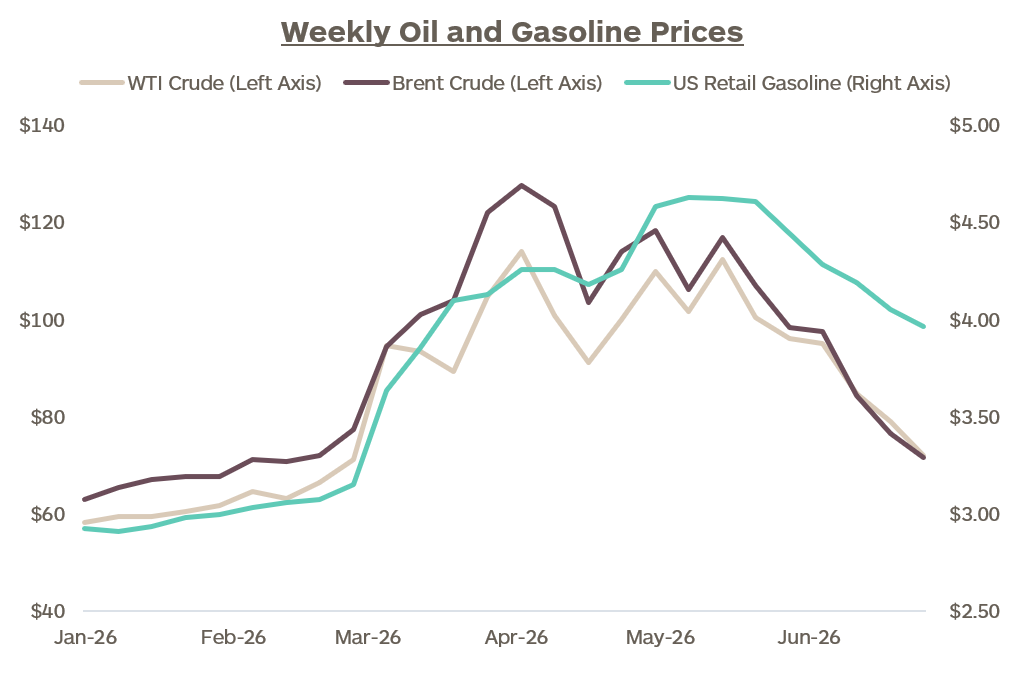
Source: Cerity Partners, YCharts, 1/1/2026–6/30/2026
The seemingly global pivot toward monetary tightening took the wind out of the sails of the gold trade in the second quarter. With valuations having declined to much more reasonable levels and commodity inflation less of a concern, gold buyers may begin to anticipate a resumption of monetary ease. Incremental diversification away from the US dollar should be a multiyear theme, and with most other currencies suffering from debasement concerns, gold could again become the preferred alternate store of value for global investors and central bankers.
While the global market environment can turn very quickly, reduced geopolitical tensions will mitigate the need for currency havens like the Swiss franc and US dollar. Relative economic growth and interest rates continue to favor the dollar against most other currencies but any pivot back to easier monetary policies would likely provoke some weakness. Look for the dollar to trade in a rather narrow range around current levels for the rest of the year.
Please read important disclosures here.