

Q3 2026 in review
Two gradual realizations defined the third quarter of 2026 for investors. First, there is no clear path to a near-term resolution to the conflict in Iran and the accompanying energy supply disruptions. Second, the Federal Reserve (Fed)—under new leadership—is no longer content to address stubborn inflation with jawboning and can-kicking.
The “fragile ceasefire” we described in last quarter’s review proved to be just that. By mid-July, renewed clashes in the Strait of Hormuz prompted the United States to reinstate its blockade of Iran, voiding June’s memorandum of understanding and reducing traffic through the strait to a trickle. What followed was less a hot war than a grinding stalemate, punctuated by periodic strikes, new sanctions, and offers and counteroffers that never produced a deal. As the conflict dragged on, it became increasingly clear that many of the buffers that had prevented the worst-case scenarios would not last forever. Oil, which had round-tripped to roughly $70 per barrel by the end of June, climbed toward—and briefly above—the psychologically important $100 per barrel threshold during the quarter. By quarter-end, however, reports indicated that Middle Eastern tanker traffic was nearing prewar levels, perhaps suggesting that Iran’s grip on the region was weakening. Investors are demanding a risk premium regardless.
The US economy appears to be shaking off the prolonged energy shock. Real gross domestic product (GDP) growth in the third quarter is estimated to be 3.7% by the Atlanta Fed’s GDPNow, a real-time economic growth tracker. Capital investment in artificial intelligence (AI) continues to be a major structural tailwind. The unabated data center build-out is buoying headline economic growth and helping pull the broader manufacturing sector out of its own recession, as evidenced by the July ISM Manufacturing Purchasing Managers’ Index (PMI) recording its best reading since May 2022. The cherry on top of the quarter was the September S&P Global Flash PMI report, which showed meaningful acceleration in activity for both the manufacturing and services sectors, with its composite PMI reaching its highest reading since 2021.
At the risk of sounding like a broken record, the US consumer again showed an impressive display of resilience in the face of yet another layer of headwinds. We estimate that spiking prices at the gas pump have cost each household roughly an additional $500 since the conflict with Iran began. While this increase has been meaningful for lower-income consumers, in the aggregate, consumers have taken it in stride. Low household leverage helps. So does an increasingly influential cohort of wealthy, debt-free baby boomers, who as net savers stand to benefit from higher rates rather than suffer from them.
The labor market struggled to break free from its “no hire, no fire” rut, but it did show some signs of life to end the quarter. Nonfarm payrolls grew by a tepid 21,000 in July (revised up from the original report of a loss of 23,000 jobs), but August brought a nice acceleration with 162,000 new jobs, nearly triple economist estimates. With evidence of widespread layoffs still virtually nonexistent, the unemployment rate fell from 4.3% to 4.1% over the quarter, while wage growth cooled to 3.1% year over year.
Inflation data offered mixed signals. After June’s Consumer Price Index (CPI) registered the first monthly decline in aggregate prices since 2020, July delivered another cool report, with prices rising just 0.1% on the month. Even so, Fed Chair Kevin Warsh and the committee held rates steady at the July Federal Open Market Committee (FOMC) meeting while striking a notably hawkish tone; three voters dissented in favor of an increase. The “hawkish pause,” as we described it at the time, only served to confuse investors, who—without clear insight into the Fed’s reaction function—struggled to reconcile words with actions.
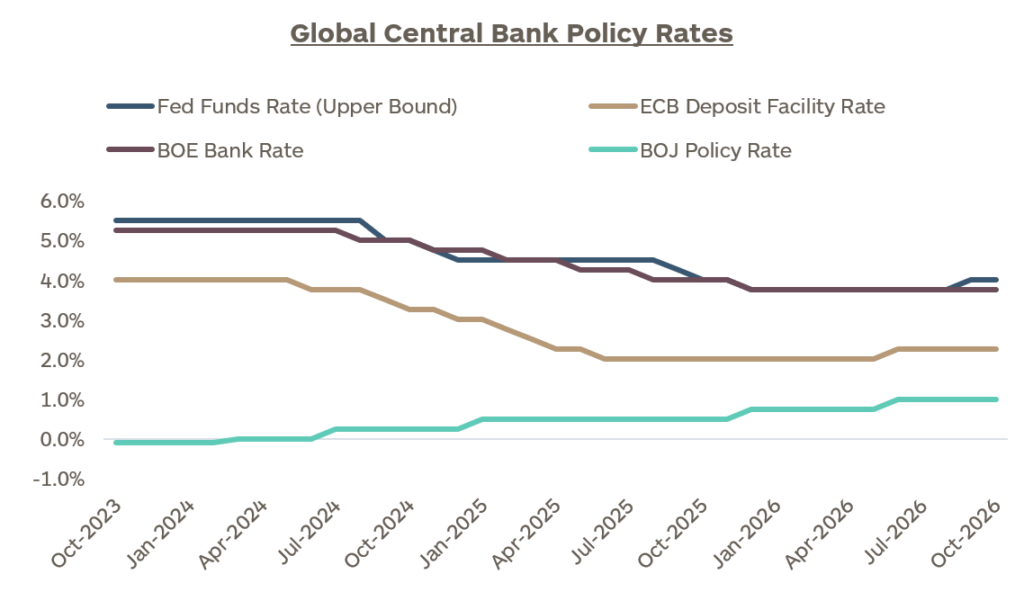
In August, Warsh used his highly anticipated speech at the Fed’s annual economic symposium in Jackson Hole, Wyoming, to clear the air, brushing off recent data to focus on longer-term inflation stickiness while observing that he did not see financial conditions as restrictive and warning that “price stability is not self-executing.” The speech, followed by a relatively hot August CPI report, pushed market odds of a rate hike to a near certainty by the time the September meeting rolled around. On September 16, the FOMC delivered, raising rates 25 basis points to 3.75%–4.00%, with the “dot plot” signaling one more hike in 2026. Futures markets now see roughly one-in-three odds that it comes as soon as October. The Fed’s action echoed a broader shift toward tighter monetary policy globally. Faced with resilient economies and an energy price shock, rate hikes were delivered by the European Central Bank and the Bank of Japan, with the Bank of England holding steady but also leaning incrementally hawkish.
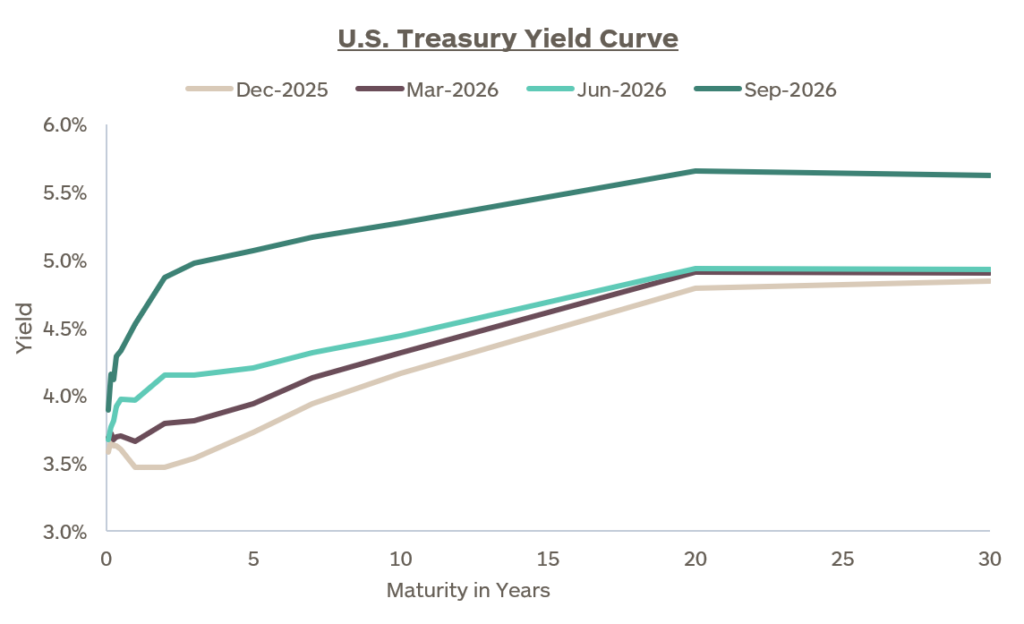
What could be the first of multiple rate hikes added to a powder keg of catalysts that drove interest rates higher, with the upward move accelerating in September. Long-term Treasury yields finally broke out of their five-year range as the 10-year yield climbed from below 4.5% at the start of the quarter to over 5.2%, its highest level since before the global financial crisis and a full percentage point above where it began the year. The list of upward catalysts is long, including sticky inflation, elevated energy prices, a wave of new bond issuance from AI hyperscalers, and fiscal concerns. The Treasury’s decision to triple its long-end buybacks did little to stem the tide. For all the attributing narratives, we put the most weight on one of the simplest: strengthening economic growth. One bright spot for bond markets during the quarter was credit spreads, which held close to historical lows in an apparent vote of confidence that higher financing costs wouldn’t cause much fundamental deterioration.
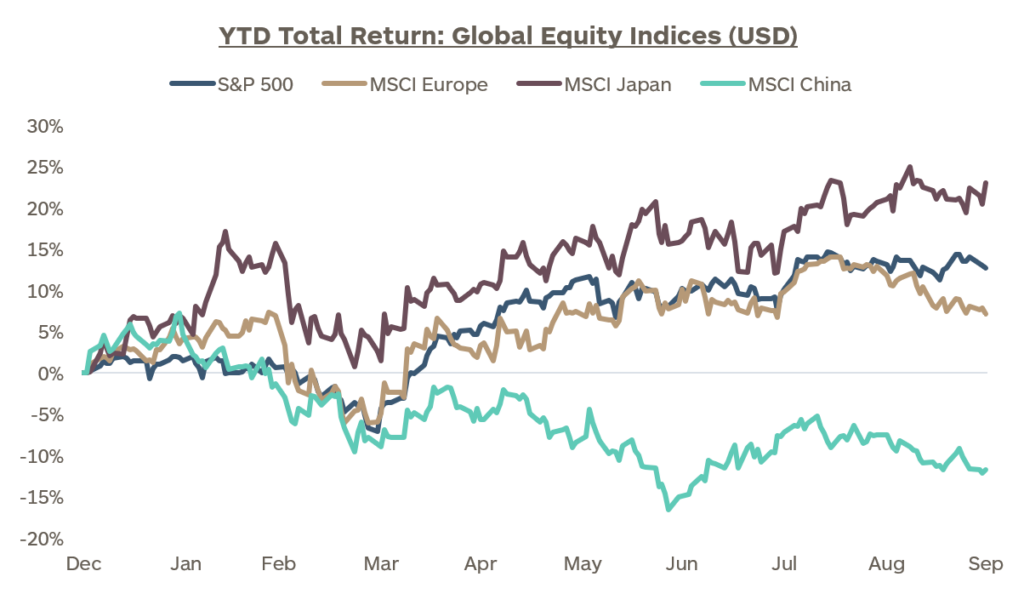
Equity investors handled everything commodity and bond markets threw at them surprisingly well. It was a choppy summer to be certain, but the S&P 500 set a new record high in August before taking a slight breather in September. After another march toward oil at $100 per barrel and 10-year Treasuries breaking comfortably north of 5%, to have the S&P 500 end the quarter within 1.5% of its high feels like a great achievement. Under the surface, the picture worsened a bit as equity market breadth deteriorated notably. Large-cap technology stocks took back the leadership baton with an upward push by the Nasdaq-100 Index to end the quarter. Meanwhile, the rest of the S&P 500 spent the quarter treading water, while the small-cap Russell 2000 Index ended the quarter down over 8%, not far off correction territory.
The biggest tailwind for stocks continues to be stellar earnings growth. Second-quarter S&P 500 earnings grew 52% year over year, the fastest pace since 2021. One-time investment gains at Alphabet and Amazon boosted that figure, but even excluding those two companies, earnings grew an impressive 34%. Analysts expect nearly 30% growth for the third quarter. With earnings outrunning prices, valuations actually compressed, as the forward price-to-earnings ratio slipped from about 20.4x at the end of June to roughly 19x.
The US dollar was largely range-bound during the quarter, with the US Dollar Index ending the quarter near 101, little changed from where it started but well off its February low of 96. The action in currency markets came from Japan, where persistent yen weakness was met with a powerful joint intervention by the US Treasury, which was likely acting to limit a source of selling pressure into a weakening market for Treasury bonds.
Gold climbed to nearly $4,600 per ounce in late August before the Fed’s hawkish turn took some of the shine off, leaving the metal modestly higher for the quarter but still down for the year. The inverse relationship between real interest rates (which have driven the move in Treasury yields rather than inflation expectations) and gold prices is starting to reestablish itself after breaking down in the wake of Russia’s invasion of Ukraine more than four years ago.
Taken together, the quarter’s developments reinforced an unusual investment backdrop: growth accelerated even as inflation and energy risks kept monetary policy restrictive. Strong earnings continued to support large-cap equities, but rising yields, narrowing market breadth, and weakness among smaller companies showed that resilience was becoming less evenly distributed. The central question entering the fourth quarter is whether economic and earnings momentum can continue to offset the pressure from higher financing costs.
Our outlook for the year
Global economy
World economic growth should continue to hover around 3.0% for the last quarter of 2026 and into next year, as the massive boom in capital investment for AI is effectively offsetting the price shocks emanating from the Middle East and Russia-Ukraine wars. Expansionary fiscal policy has helped drive US growth this year while Europe should benefit in 2027 from greater defense spending. Monetary policy will be incrementally tighter over the coming months but probably not tight enough to seriously impact global demand.
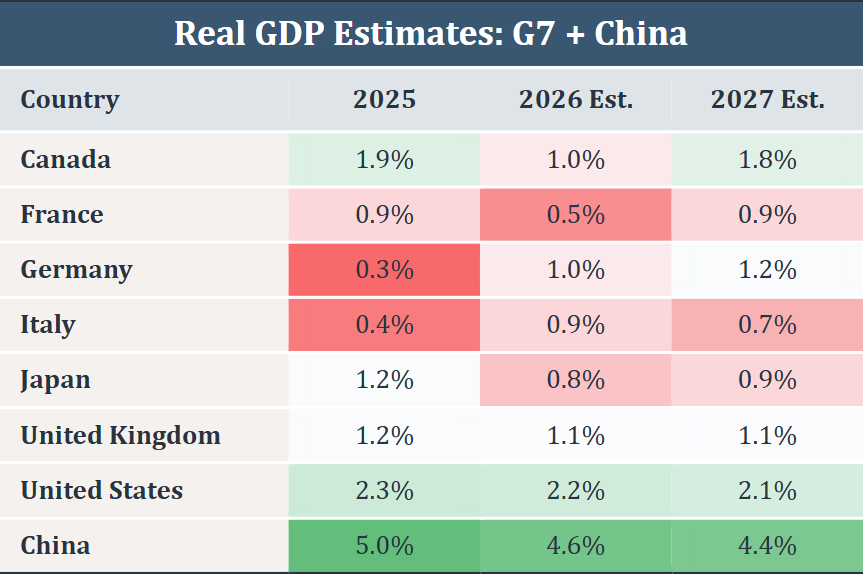
US GDP growth appeared somewhat disappointing over the first half of 2026, as very strong consumer and capital spending was offset by a decrease in government spending and a sharp increase in the trade deficit. Tax cuts provided in last year’s One Big Beautiful Bill Act partially fueled the growth in consumer and business spending seen so far this year. The government spending decline occurred because of a methodological quirk involving release of oil from the Strategic Petroleum Reserve, the world’s largest supply of emergency crude oil. The deterioration in the trade deficit was due largely to higher imports, which is effectively a confirming sign of US consumer spending strength. When third-quarter growth is reported at the end of October, these government spending and net export components will likely neutralize or even potentially reverse to the extent that consumer and capital spending will be a driver of above-trend growth of roughly 3.0%. With trade still being somewhat of a drag, growth should settle back to the 2.0% level for the fourth quarter. Increased capital spending at higher price levels in the energy sector should add to ongoing technology expenditures while the US consumer continues to spend in a stable labor market with ample wage growth.
Source: Cerity Partners, FactSet as of 10/5/26
While by no means growing at trend due to the war-related impact of higher energy prices, European economies have surprised forecasters by staying out of recession. The combined economies are anticipated to grow at roughly 1.0% for all of 2026. Spain, with its strong service economy, should continue to be a standout as consumer spending remains geared toward experiences. Italy and France are expected to be laggards, as the manufacturing sectors in these economies do not benefit from the strong AI tailwind currently being seen in the United States and Asia. Germany, the largest economy in Europe, is embarking on a defense spending initiative and an uncharacteristic increase in deficit spending that should help boost growth across the entire Continent.
Economic growth in Japan will likely be positive at roughly 0.6% in the fourth quarter, but it will be subdued by the effect of higher energy prices and the continued demographic challenges of an aging country. Unlike recent retirees in the United States who have benefited greatly from equity and home price appreciation and are spending rather freely in their early retirement years, elderly people in Japan did not experience the same kind of asset price appreciation in their financial markets and are spending more cautiously. Capital spending should grow strongly on the back of the AI advance, but exports may continue to struggle due to softer demand growth from China, Japan’s second-largest export market.
China has become quite the bifurcated economy over the last few years as the manufacturing sector continues to grow strongly, with the country becoming a formidable competitor in the AI boom. This momentum has helped provide a further boost to the strong export industries that have so far effectively withstood the damaging impact of US tariffs. The Chinese consumer is struggling with the continued fallout from the domestic property crisis, which is keeping spending growth rather listless. Government fiscal support is expected to remain ample, but it is largely targeted to support the less efficient state-owned enterprises.
Monetary policy
In his first few months on the job, recently installed Fed Chair Kevin Warsh has reiterated that the primary goal of the Fed at this time is to restore price stability, defined as the core Personal Consumption Expenditures (PCE) inflation rate falling to 2.0%. With the core PCE being quite a distance from the target at 3.0% heading into the fourth quarter, there is a high probability of at least one more federal funds rate hike in 2026. With so much of the inflation outlook dependent upon the prospective duration and magnitude of the Iran war, it is difficult for economic analysts to predict the timing for any meaningful energy price relief. Before the war began, inflation appeared to be moving inexorably down toward the target. So, any stabilization of energy prices may allow this downward drift to resume, with the biggest risk now being a monetary policy that becomes too tight in an economy already experiencing the contractionary effect of higher prices.
Source: Cerity Partners, YCharts as of 10/1/26
The various central banks of Europe all have a single price-stability mandate and with higher energy prices basically a global supply constraint phenomenon, they all have a tightening bias as we approach year-end. With economic growth rather anemic across the Continent and much less exposure to the rate-insensitive AI technology advance, we may see a higher probability of a policy error at the Bank of England, the European Central Bank, the Swiss National Bank, and the Nordic central banks. Perhaps lessons learned from past tightening moves into an economy that is already slowing can better guide these central bank institutions. The recent decision by the Bank of England to hold the policy rate steady may be indicative of a better understanding of the limits of monetary policy. But for now, the tightening bias and its ultimate effect on the European economies and markets lead to a more cautious stance among investors.
The Bank of Japan (BOJ) may be a little less independent of the central government than is typically seen in the United States and Europe, but BOJ Governor Kazuo Ueda has been able to embark on a tightening campaign, bringing the key policy rate from basically zero to a still-low 1.25%. With Prime Minister Sanae Takaichi favoring a more accommodative policy, the BOJ will likely continue to move cautiously in an economy with many near- and long-term challenges. The People’s Bank of China (PBOC) is not experiencing the same kind of inflationary pressure that is driving policy at most other central banks around the world. Weak consumption and strong production are restraining consumer prices, so the PBOC can theoretically ease policy, but the Chinese government remains concerned about capital flight out of the country if relative interest rates become too low against other key countries and currencies. We anticipate the key policy rate will remain stable over the next six months.
Bond markets
Higher energy prices, stronger-than-expected economic growth, stubborn core inflationary data, and ever-expanding fiscal deficits all combined to drive a notable upward shift in the US yield curve over the summer months. With yields on Treasury notes at levels not seen in 20 years, investors are becoming increasingly interested in both the asset class and extending duration within the asset class. Given high nominal GDP growth right now and elevated oil prices, there is likely no rush to get into an investment-grade asset class that has finally reached fair value after being incredibly expensive for years. The changing shape of the yield curve may provide an interesting signal, as a flattening could indicate slower economic growth and an eventual lower rate trajectory, while steepening is predictive of a stronger economy in which rates can continue to move higher.
Source: Cerity Partners, FactSet as of 10/1/26. Past performance is no guarantee of future results.
Credit spreads in both the investment-grade and high-yield bond asset classes can also provide clues to the future state of the economy. A slight widening of spreads occurred at the end of the third quarter but only to levels still indicative of very low default risk in what is a rather strong US economy with a low probability of recession over the next few years. Higher nominal yields with slightly wider spreads are making credit issues relatively more attractive to government bonds for the first time in a while. With spreads of approximately 300 basis points above like-maturity Treasury notes, high-yield bonds begin the fourth quarter with attractive 8.0% yields.
It has been a difficult year for municipal bonds, as a large increase in supply exacerbated the impact from higher Treasury rates. With the tax-exempt curve now steeper than the taxable market and the sector still showing solid debt coverage fundamentals, municipal bonds are looking increasingly attractive for both direct investment and for possible duration extension.
Equity markets
With US equities delivering strong mid- to high-teens returns over the first three quarters of the year, investors are beginning to question valuation levels as they contemplate the remainder of this year and look ahead to 2027. Higher interest rates are indeed a valuation headwind that has been completely offset by very strong earnings growth. Full-year 2026 earnings growth is expected to be more than double the year-to-date return on US stocks. The approximately 30% earnings growth this year is unprecedented, as that type of growth only occurs when the economy is emerging from recession. Earnings in 2027 are expected to slow from this phenomenal base but still register 15% growth, led largely by the beneficiaries of the AI spending boom. Current valuation on these 2027 earnings is approximately 19x, which we consider fair at current interest-rate levels. Further rate increases would likely present additional valuation headwinds, but if rates stabilize around current levels, US equities appear to be reasonably priced.
Breadth of participation had improved notably through most of the year before interest rates began rising during the summer. As AI-related stocks account for the bulk of the outsized earnings growth and are not currently very rate sensitive, the remaining names in the index are subject to greater multiple contraction in a rising rate environment. An end to the war in Iran and some stabilization and eventual decline in oil prices would be helpful in again broadening participation in this continuing bull market.
Source: Cerity Partners, FactSet, 12/31/25–9/30/26. Past performance is no guarantee of future results.
European equity markets are far less exposed to the AI advance than the US and many other Asian markets, but their significant valuation discounts since the start of the year have allowed them to largely match US returns. Higher rates will be a much larger headwind to these rather cyclical markets, so higher oil prices and a further increase in rates should bring greater investor caution in navigating both UK and continental European markets. Also beginning the year at a significant discount to US stocks, Japanese equities have outperformed US equities, as many Japanese companies are in the technology supply chain benefiting from the AI advance. Expansionary fiscal policy has also helped maintain economic growth. After having risen over 30% through the first three quarters of the year, higher oil prices and monetary tightening at the BOJ are cautionary headwinds that may entail some necessary digestion before resuming a further advance. The potential unwinding of the Japanese yen carry trade as the currency continues to weaken may further pressure the Nikkei 225 and TOPIX indexes.
Chinese equities have dramatically underperformed most other global equity markets so far in 2026, as China’s weak consumer sectors have fully offset any advances seen in its technology companies. Government authorities have been hesitant to provide sufficient stimulus to its publicly traded sectors that are being hurt by US tariffs and threatened sanctions. From a contrarian and valuation perspective, the markets look interesting at these levels if investors believe some of these longer-term issues are fully reflected in current equity prices.
Commodities and currencies
Energy prices will continue to move with the ebb and flow of the war in Iran and to a lesser extent the ongoing Russia-Ukraine conflict. Outside of these geopolitical issues that are affecting production and distribution, the oil and gas markets would be in an oversupply situation, so any easing of hostilities would have meaningful downside price implications. Industrial metals are also seeing supply constraints due to both the conflicts and the ongoing tariff wars. Demand in these markets is robust and pushing prices higher in a healthy global economic growth environment. So, any thaw geopolitically may not have the same salutary effect on prices as should occur in the energy sector.
Gold is being impacted by two countervailing forces. The pivot toward what may be longer-term tightening cycles at many global central banks has made short-term money market instruments more attractive against the yellow metal. But the trend of central banks looking to diversify US dollar exposure seems entrenched, as aggressive US trade policies and threat of sanctions increase. Recent and prospective monetary tightening is likely not enough to end fears of secular currency debasement in a world of ever-growing fiscal deficits. We believe gold will continue to provide an effective longer-term hedge against such debasement.
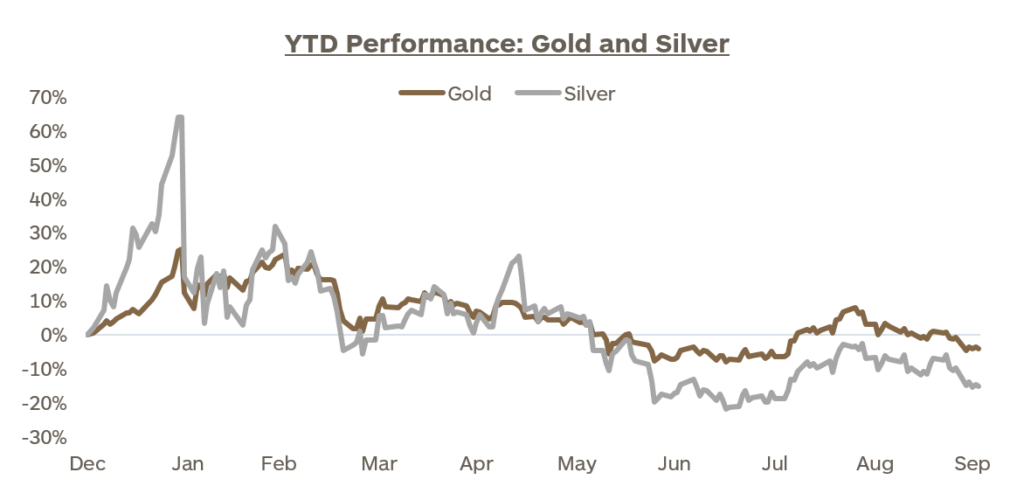
Source: GLD and SLV ETFs, Cerity Partners, YCharts, 12/31/25–9/30/26. Past performance is no guarantee of future results.
With the Fed seemingly committed to maintaining a tightening stance in the face of stubbornly high inflation, a floor has likely been placed under the dollar against most other currencies. The relative strength and interest-rate levels of the United States are also favorable to the greenback, although some expected improvement in the inflation outlook should keep interest rates from spiking notably higher from current levels. Having broken out of a rather tight trading range since the Fed started to strongly signal an increase in rates, the dollar should be able to establish a new, narrow range with these higher levels as a midpoint.
Please read important disclosures here.