

Executive Summary
Historically, investments in privately held assets have generally produced higher returns than those in publicly traded assets. However, sustainable outperformance for limited partners (LPs) requires active allocation, and the dispersion of returns across LPs tends to be very wide.
The broader investment community often cites the ‘illiquidity premium’ as a compelling reason for alpha and value add in private market returns. Cerity Partners Institutional Consulting (CPIC) believes that illiquidity is not a primary driver in generating excess returns. Rather, institutional investors must gain comfort in dealing with the liquidity issues associated with private markets. Excess returns mostly come from concentration and manager skill.
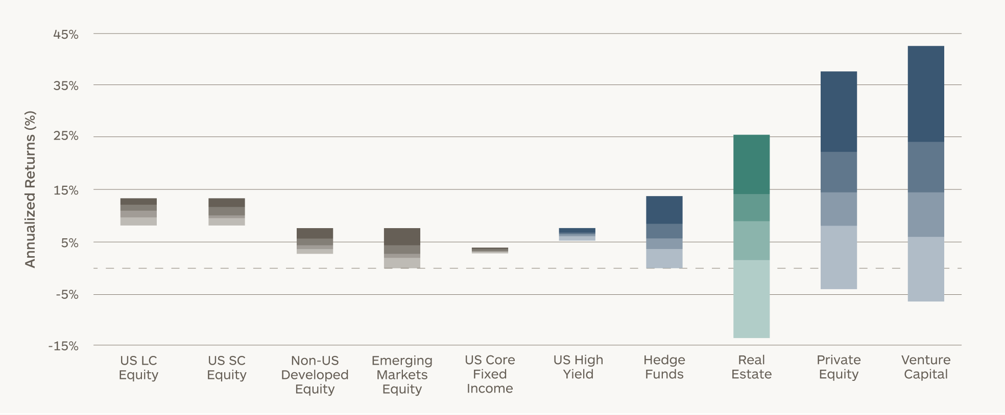
Compared to the public markets universe, there exists significant dispersion of returns between top quartile and bottom quartile managers across each private markets asset class. This has been most pronounced in venture capital (VC) and private equity (PE).
DISPERSION OF MANAGER RETURNS BY ASSET CLASS — BASED ON RETURNS OVER 15 YEARS
Understanding the role of private markets managers
Private markets managers play a crucial role in the investment ecosystem. General partners (GPs) are responsible for sourcing investment opportunities, conducting thorough due diligence, structuring deals, and managing the portfolio through exit. An exceptional manager not only excels in these areas but also demonstrates a deep understanding of industry trends, has a robust network of relationships, and possesses the acumen to adapt strategies in response to shifting market conditions.
There are a few key due diligence processes that can help maximize the likelihood of consistently selecting top quartile managers.
The importance of track record
One of the most critical factors in evaluating private markets managers is their track record. Historical performance provides a window into a manager’s ability to generate returns and manage risks.
However, it is essential to look beyond headline figures and consider the context in which returns were achieved. This includes examining the economic environment, the types of investments made, and the strategies employed. A consistent track record of success across different market cycles often indicates a manager’s resilience and skill.
There are a few key due diligence processes that can help maximize the likelihood of consistently selecting top quartile managers.
Assessing investment philosophy and strategy
An exceptional manager will have a clear and coherent investment philosophy and strategy. This should be well-articulated and supported by a logical framework that explains how value is created. Investors should look for managers who can demonstrate a disciplined approach to investment selection and portfolio construction. This includes a well-defined process for sourcing deals, conducting due diligence, and managing investments post- acquisition. Additionally, managers should be able to articulate how they mitigate risks and capitalize on opportunities.
The role of team and culture
The strength and cohesion of the management team are paramount in determining the success of a private markets manager. A high-performing team will have a complementary mix of skills and experience, with clear roles and responsibilities. It is also important to assess the stability of the team, as high turnover can be a red flag. The culture of the organization should foster collaboration, innovation, and ethical behavior. A strong culture can be a significant driver of long-term success and alignment of interests between the manager and investors.
Network and deal flow
Access to high-quality deal flow is a distinguishing feature of exceptional private markets managers. This is often driven by a robust network of industry contacts, including entrepreneurs, corporate executives, and other investors. A manager’s ability to source proprietary deals and gain early access to attractive investment opportunities can significantly enhance returns. Therefore, assessing the breadth and depth of a manager’s network is a critical component of the due diligence process.
Operational capability and value creation
Beyond sourcing and executing deals, exceptional managers add value through active portfolio management. This includes strategic guidance, operational improvements, and market positioning to drive growth and profitability. Investors should seek managers with a proven track record of operational excellence and value creation. This involves assessing case studies of past investments and understanding how the manager has influenced outcomes positively.
Alignment of interests
Alignment of interests between managers and investors is crucial in private markets. This can be achieved through various mechanisms, such as LP friendly fees and terms, investment professionals’ personal skin in the game, and clear communication. A manager’s commitment to aligning their interests with those of their investors often indicates a long-term perspective and dedication to achieving shared goals.
Due diligence process
The due diligence process is critical to selecting exceptional private markets managers. This involves a comprehensive evaluation of the manager’s track record, investment philosophy, team, network, operational capability, and risk management practices. Investors should also conduct reference checks and seek feedback from industry participants. A thorough due diligence process helps to mitigate risks and increase the likelihood of selecting managers who can deliver superior returns.
Conclusion
Picking exceptional private markets managers requires significant pattern recognition and experience. It necessitates a deep understanding of the investment landscape, rigorous analysis, and the ability to identify the qualitative and quantitative factors that drive success. By focusing on track record, investment philosophy, team strength, network, operational capability, risk management, and alignment of interests, investors may enhance their chances of selecting top-tier managers that can navigate the complexities of private markets and deliver outstanding returns.
In short, the journey to selecting exceptional private markets managers is fraught with challenges, but the rewards can be significant. By adhering to a disciplined and comprehensive approach, investors can uncover the gems in the private markets space and position themselves for long-term success. For more information regarding our thoughts on private markets manager selection, please reach out to your Cerity Partners Institutional Consultants.
Cerity Partners Retirement Plan Advisors LLC d/b/a Cerity Partners Retirement Plan Consultants and Cerity Partners Institutional Consulting (“RPC”, “CPIC”, “we,” “us” or “the Adviser”) is registered with the U.S. Securities and Exchange Commission as an investment adviser and is a wholly-owned subsidiary of Cerity Partners LLC. Registration as an investment adviser does not imply any level of skill or training.
The information contained herein is not personalized investment, tax, or legal advice and is for informational purposes only. There is no guarantee that any views or opinions expressed will come to pass. This information is subject to change without notice and should not be considered an offer to sell or a solicitation to buy any security. Past performance is not indicative of future results. Before making any decision that may affect your retirement plan or finances, consult a qualified professional adviser.
© 2026 Cerity Partners Retirement Plan Advisors LLC. All rights reserved.
Please read important disclosures here.