

At nonprofits, foundations, and other mission-driven organizations, the investment office is being asked to do more in an increasingly demanding environment. Funding sources are under pressure, and competition for donor dollars remains intense. Meanwhile, increased sophistication of portfolio options requires disciplined oversight and specialized expertise from boards and investment committees with limited time and resources.
These pressures are causing many organizations to reexamine whether their current approach to investment decision-making and implementation can keep pace with their long-term goals. This is where the Outsourced Chief Investment Officer (OCIO) model comes in. For some organizations, outsourcing provides access to professional investment oversight while reducing the demand on internal resources.
The decision to outsource goes beyond evaluating the OCIO model. The market has grown rapidly, and providers vary significantly in their structures, service models, investment approaches, and levels of customization. Understanding those differences is crucial for evaluating whether an OCIO partnership is the right fit.
What is an OCIO?
An Outsourced Chief Investment Officer, or OCIO, is a third-party firm that takes on or shares the duties that would otherwise be assigned to an in-house chief investment officer. An OCIO is entrusted with making and implementing investment decisions on behalf of an organization, within agreed-upon guidelines. Services typically include asset allocation, manager selection, portfolio rebalancing, risk management, performance reporting, and governance support.
The OCIO model is commonly used by nonprofits, endowments, foundations, healthcare systems, and family offices seeking professional oversight, reduced administrative burden, and access to sophisticated investment strategies. By outsourcing investment responsibilities, these institutions can focus on their mission and long-term strategic goals rather than the demands of day-to-day portfolio management..
Rapid growth and increased specialization
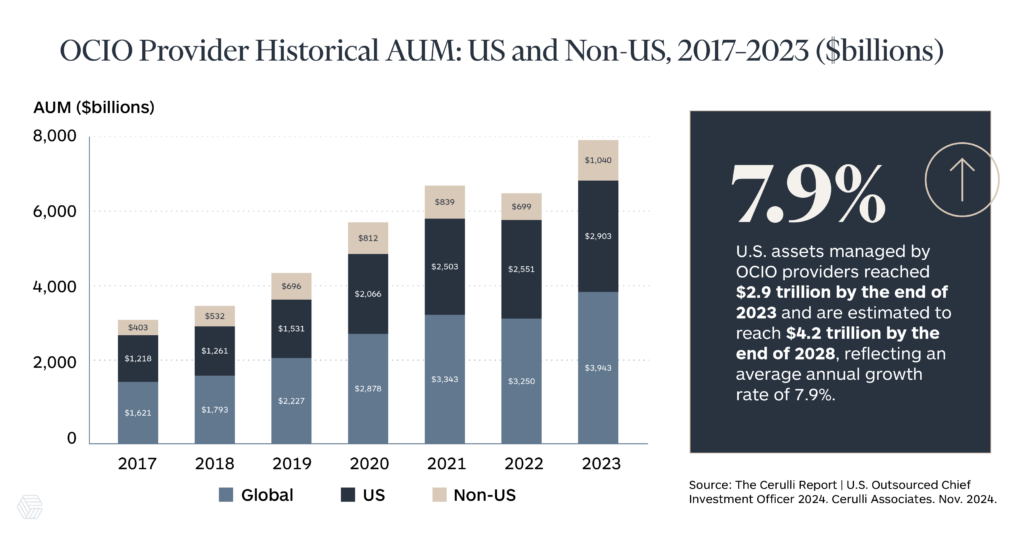
According to Cerulli Associates (Nov 2024), US assets managed by OCIO providers reached $2.9 trillion by the end of 2023 and are estimated to reach $4.2 trillion by the end of 2028, reflecting an average annual growth rate of 7.9%. As capital has poured into the model, the market has rapidly segmented by client size, institution type, and the specific level of customization required to deliver targeted services.
Because the market has scaled so rapidly, today’s providers are no longer one-size-fits-all. The modern OCIO landscape has consolidated into three primary business models, each offering distinct advantages depending on an institutional investor’s size, needs, and governance structure:
- Asset managers and bank divisions leverage massive internal trading desks and proprietary funds.
- Consulting firm extensions originate from traditional institutional advisory lines to offer discretionary implementation.
- Boutiques specialize in highly customized, portfolios for niche asset pools.
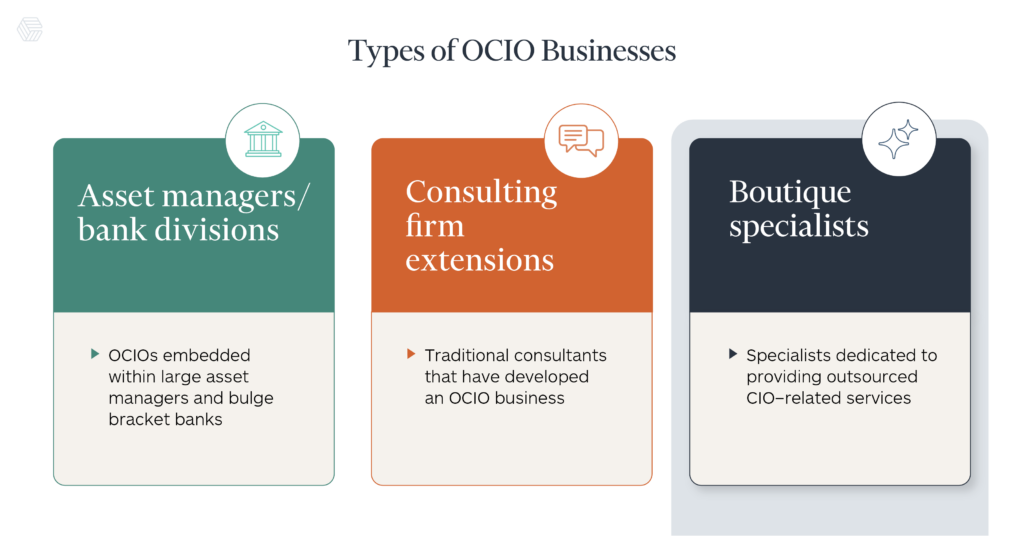
Each offers distinct advantages depending on the needs, size, and governance structure of the institutional investor.
1. Asset managers and bank divisions
OCIO divisions of banks and asset managers typically offer a broad suite of financial services beyond investment management, often providing access to proprietary products or solutions.
What sets them apart:
- Access to extensive resources, infrastructure, and research capabilities
- Integration with other financial services, such as custody, banking, lending, and actuarial services
- Significant scale and operational support
May suit institutions:
- That are comfortable with the use of proprietary products and their inherent conflicts of interest
- With a preference for scaled solutions designed for a large client base
- Requiring specialized expertise to manage operational complexity, such as pensions or defined benefit plans
2. Consulting firm extensions
Many traditional investment consultants have evolved to offer OCIO services alongside their legacy advisory businesses.
What sets them apart:
- Deep institutional knowledge and governance expertise
- Strong analytics and benchmarking tools
- Relationships that are often nondiscretionary or semi-discretionary
May suit institutions:
- Seeking to retain a measure of discretion
- Looking to deepen established consultant relationships
- Seeking a larger provider backed by the deep research, data, and global benchmarking tools of a major consulting firm
3. Boutiques
Boutique OCIOs are purpose-built to deliver Outsourced Chief Investment Officer services. They typically focus on discretionary investment management for a select number of institutional clients.
What sets them apart:
- Customized solutions based on each client’s unique needs and goals
- High-touch client service model with a focus on partnership
- Emphasis on mission-driven organizations
May suit institutions:
- Seeking customized investment solutions rather than one-size-fits-all models
- Looking for a specialist who works with similar organizations
- Requiring support beyond the portfolio, such as donor relations and education
One size does not fit all
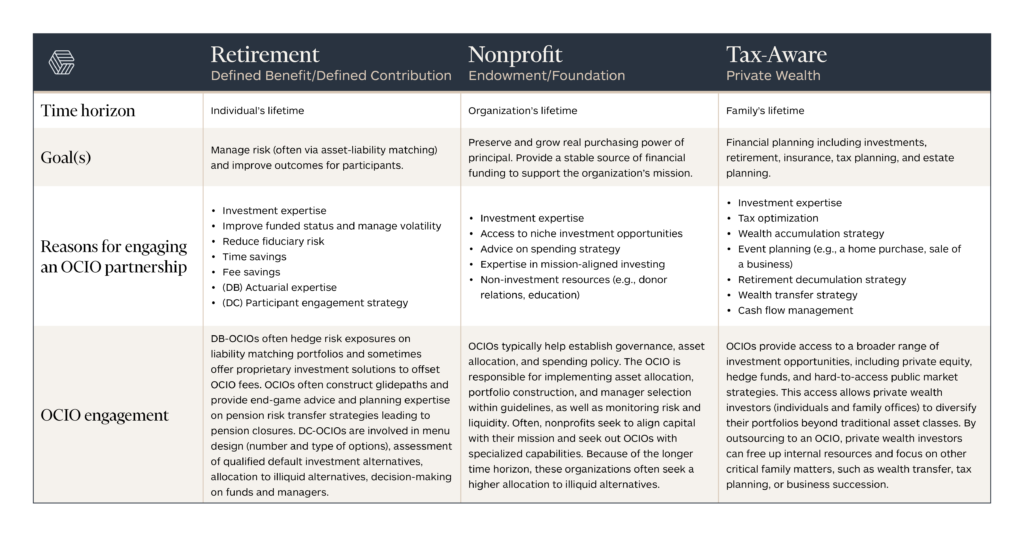
Each sector of the institutional investor universe has different needs and requirements for achieving its objectives. The table below illustrates key differences in goals, needs, and OCIO engagement objectives.
Expertise and adaptability are key
Factors such as increased geopolitical uncertainty, and the acceleration of AI have led to an increasingly complex investment landscape. In tandem, the OCIO market will likely continue growing and specializing to meet the heightened needs of institutions. This gives clients more choice, but it also makes provider selection more important.
The right OCIO model depends on an organization’s goals, governance structure, internal resources, and need for customization. By understanding the differences among provider types, institutions can better evaluate their options and choose a partner aligned with their long-term objectives.
Cerity Partners OCIO is a boutique firm offering customized Outsourced Chief Investment Officer solutions to endowments, foundations and family offices. We have significant experience partnering with mission-driven organizations for over 15 years. Learn more about how our solutions can help you.
Cerity Partners LLC (“Cerity Partners”) is an SEC-registered investment adviser with office locations throughout the United States. Registration of an Investment Advisor does not imply any level of skill or training. OCIO assets are managed by Cerity Partners OCIO LLC (“Cerity Partners OCIO”), a wholly owned subsidiary of Cerity Partners.
The information presented is limited to general information pertaining to Cerity Partners’ services, views, outlooks, and opinions and is for informational purposes only. Information is presented for illustrative purposes only and does not constitute an exhaustive explanation of relevant considerations when evaluating an OCIO provider. The information contained herein should not be construed as investment, tax, legal or fiduciary advice. There is no guarantee that the views and opinions expressed will come to pass. Before making any decision or taking any action that may affect your finances or your company’s finances, you should consult a qualified professional adviser. The information presented is subject to change without notice and is deemed reliable but is not guaranteed.
Investing involves risk, including the possible loss of principal and fluctuation of value. There is no assurance objectives will be met. Alternative investments can be speculative and may not be suitable for all investors.
Certain information is based on or derived from independent third-party sources that, in certain cases, may not have been updated through the date of this information. While such information is believed to be reliable for the purposes used herein, Cerity Partners has not independently verified the assumptions on which such information is based nor assumes any responsibility for the accuracy or completeness of such information.
©2026 Cerity Partners LLC. All Rights Reserved.
Please read important disclosures here.