
Nonprofits are being squeezed from multiple directions. Federal funding has become less reliable. Demand for services continues to rise. Operating deficits are more common. Organizations are increasingly asking private donors and other funding sources to close the gaps, which means competition for charitable dollars is intensifying.
These same pressures impact an organization’s investment portfolio. In this climate, investment committees need a plan to cover pressing near-term projects without compromising the organization’s long-term financial strength.
It’s a difficult balance requiring resource-intensive financial planning. Yet many nonprofit investment committees are composed of volunteers who meet only a few hours each quarter. Even for organizations with internal resources, the time and infrastructure needed to manage increasingly complex portfolios has not always kept pace. For these reasons, nonprofits are reexamining their investment management approach.
Why OCIO is gaining attention
To address these challenges, some organizations are turning to Outsourced Chief Investment Officer (OCIO) partnerships. This model outsources investment programs to institutional providers that operate with discretion, enabling nonprofits to focus on mission-driven work while benefiting from professional portfolio management. According to Cerulli Associates’ “U.S. Outsourced Chief Investment Officer Function 2025” report, more than one-third of total endowment assets (35%) were managed by an OCIO as of year-end 2024; total assets managed by OCIOs are expected to grow 11.3% annually over the next five years.
Investment expertise and access
For many nonprofits, the case for an OCIO partnership begins with two distinct needs: securing dedicated investment expertise and gaining access to specialized market opportunities that are difficult to source independently.
The case for dedicated expertise
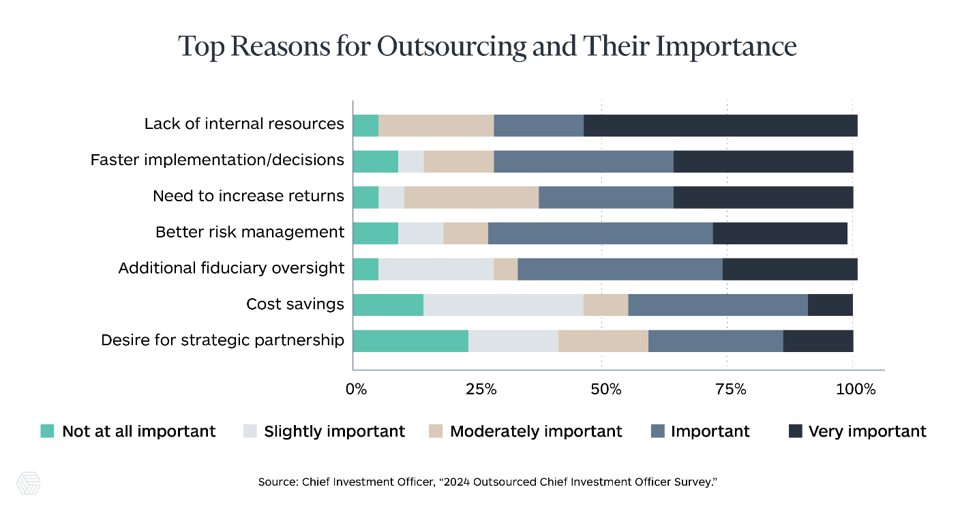
The increasingly sophisticated nature of global financial markets demands experienced professionals with a dedicated focus on investing. While traditional assets require continuous monitoring, modern portfolios require deep operational oversight that standard volunteer boards simply lack the time or mandate to provide. Because investment committees meet only a few hours each quarter, they cannot dynamically adjust to rapid market shifts or manage complex risk modeling, making full-time, dedicated professional expertise a necessity rather than a luxury.
The case for institutional access
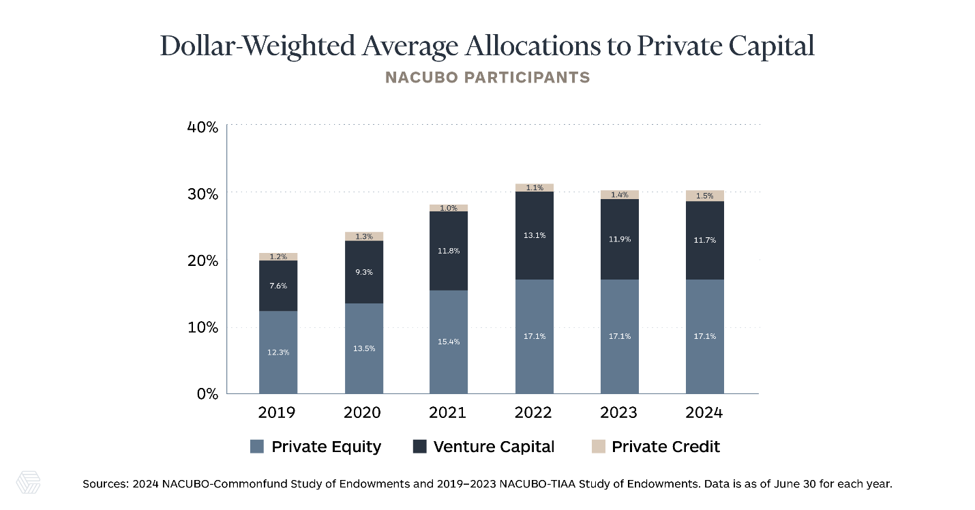
This gap in specialized capabilities becomes even more pronounced as nonprofits look beyond public markets. According to data from the National Association of College and University Business Officers (NACUBO), average allocations to private capital have increased by 44% since 2019.
However, successfully capitalizing on these opportunities presents two major hurdles for independent organizations:
- Lack of manager relationships: Top-tier, niche alternative managers are highly selective and often closed to new investors. Individual nonprofits typically do not have the established institutional relationships required to gain access to these exclusive funds.
- The complexity oversight burden: Alternative asset classes demand an immense amount of continuous due diligence, liquidity mapping, and legal vetting. Relying on a volunteer board, which may possess little to no specialized investment acumen in complex alternatives, leaves an organization poorly positioned to source, evaluate, and safely manage these high-impact investment opportunities.
An OCIO bridges this gap by leveraging their institutional scale to grant direct access to elite managers while providing the specialized day-to-day oversight required to protect the portfolio.
Gaining access to elite managers through an OCIO also delivers significant cost efficiency. Because an OCIO aggregates capital across multiple clients, they can access lower-cost institutional share classes and negotiate reduced management fees that are entirely out of reach for an independent nonprofit. This asset pooling directly translates to lower total expense ratios, ensuring more of your returns stay in the portfolio to support your mission.
Operational resources and efficiency
While investment committees set strategy, internal staff often bear the heavy burden of day-to-day portfolio operations. Smaller organizations rarely have the dedicated personnel or infrastructure required to manage complex logistics, legal compliance, and ongoing paperwork.
An OCIO alleviates this administrative load and drives substantial operational cost savings by consolidating your entire investment ecosystem. By shifting these resource-draining tasks to a dedicated partner, nonprofits benefit from:
- Turnkey administration: Delegating trade execution, portfolio rebalancing, tax reporting, and compliance so internal staff can focus entirely on advancing the organization’s mission.
- Consolidated cost savings: Leveraging the OCIO’s institutional scale to negotiate lower custody and trading fees, removing the expensive web of independent vendor costs.
- Extended institutional support: Accessing value-added services that independent teams rarely have the budget to hire internally for, including audit preparation, strategic financial planning, and donor relations support.
Dynamic risk management
Investment committees have a strict fiduciary duty to manage portfolio risk, but volunteer boards rarely have the time or specialized infrastructure to monitor exposure in real time. When a committee only meets a few hours each quarter, risk management becomes a backward-looking exercise rather than a proactive defense.
The danger of this gap is real. For example, during a sudden market downturn, a prominent university foundation faced public scrutiny and legal challenges after failing to continuously stress-test its liquidity against heavy private equity capital calls. The issue wasn’t a lack of intent; the board simply lacked the day-to-day oversight needed to spot the vulnerability before it was too late.
An OCIO eliminates this operational risk by absorbing the daily execution of portfolio defense through:
- Real-time monitoring: Tracking asset allocations daily to prevent dangerous drift.
- Liquidity mapping: Modeling cash flows so near-term spending needs are insulated from sudden market drops.
- Proactive stress-testing: Simulating macroeconomic shocks to insulate the portfolio before volatility hits.
By replacing passive quarterly reviews with continuous, institutional guardrails, an OCIO better addresses an organization’s risk management needs, giving the board absolute confidence that their assets are protected while they focus on high-level strategy.
A more resilient investment model
While no two nonprofits are alike, many share a common goal: to ensure their assets are managed wisely and aligned with long-term objectives. For organizations that need more from their portfolios, the right OCIO relationship can provide added expertise, access, and day-to-day investment support, giving leaders and committees more time for the mission.
Cerity Partners OCIO is a boutique firm offering customized Outsourced Chief Investment Officer solutions to endowments, foundations, and family offices. We have significant experience partnering with mission-driven organizations for over 15 years. Learn more about how our solutions can help you.
Cerity Partners LLC (“Cerity Partners”) is an SEC-registered investment adviser with office locations throughout the United States. Registration of an Investment Advisor does not imply any level of skill or training. OCIO assets are managed by Cerity Partners OCIO LLC (“Cerity Partners OCIO”), a wholly owned subsidiary of Cerity Partners.
The information presented is limited to general information pertaining to Cerity Partners’ services, views, outlooks, and opinions and is for informational purposes only. Information is presented for illustrative purposes only and does not constitute an exhaustive explanation of relevant considerations when evaluating an OCIO provider. The information contained herein should not be construed as investment, tax, legal or fiduciary advice. There is no guarantee that the views and opinions expressed will come to pass. Before making any decision or taking any action that may affect your finances or your company’s finances, you should consult a qualified professional adviser. The information presented is subject to change without notice and is deemed reliable but is not guaranteed.
Investing involves risk, including the possible loss of principal and fluctuation of value. There is no assurance objectives will be met. Alternative investments can be speculative and may not be suitable for all investors.
Certain information is based on or derived from independent third-party sources that, in certain cases, may not have been updated through the date of this information. While such information is believed to be reliable for the purposes used herein, Cerity Partners has not independently verified the assumptions on which such information is based nor assumes any responsibility for the accuracy or completeness of such information.
©2026 Cerity Partners LLC. All Rights Reserved.
Please read important disclosures here.