

Introduction
The purpose of a pension plan’s investment portfolio (assets) is to ensure that promised benefits (liabilities) can be paid to beneficiaries as they come due. However, many plan sponsors approach their investment policy without explicitly focusing on the liabilities that the assets support. Liability Driven Investing (LDI) is an alternative approach that we believe can offer considerable value to many public institutions.
Executive Summary
Liability Driven Investing (LDI) is an investment strategy that matches a pension plan’s future benefit payments with cashflows generated by a fixed income portfolio1. While LDI approaches are popular among corporate plan sponsors, they are less prevalent with public plans. In this Topic of Interest white paper, we explore this dichotomy in adoption between sponsor types to gain an understanding of how public sponsors can better implement LDI solutions. Next, we discuss the characteristics of pension plans that make LDI strategies beneficial. Lastly, we assess the current environment, to illustrate why LDI may appear relatively attractive today.
How is a pension plan’s financial health measured?
Pension plan sponsors measure their financial health with funded status, calculated as the plan’s assets divided by its liabilities. The plan’s actuary calculates liabilities by discounting all future expected benefit payments to participants to arrive at a present value. The discount rate used for determining the liability is the largest driver of differing levels of LDI adoption among sponsor types2. The two key types of discount rates are summarized below:
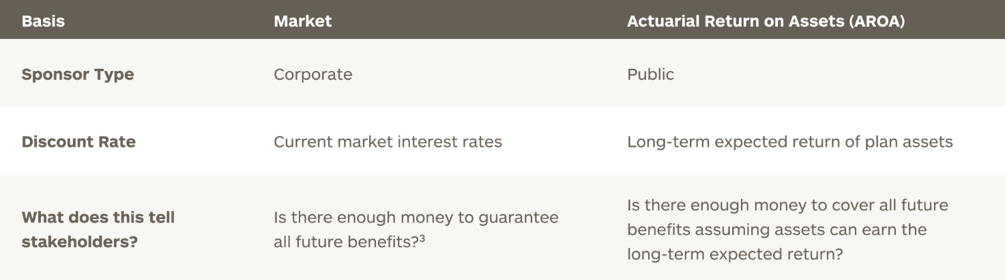
Corporate sponsors are held to market-based requirements when reporting liabilities. On this basis, liabilities are discounted at prevailing interest rates, which can lead to volatile measurements of liabilities when interest rate conditions change. Therefore, corporations tend to be concerned with managing short-term interest rate risk. LDI has proven effective for managing this risk, as it causes the asset portfolio to move in tandem with liabilities as interest rates change, resulting in less funded status volatility.
Public sponsors on the other hand, discount liabilities with the AROA, a long-term expectation for asset returns, which tends to be relatively stable over time. Therefore, liabilities are less volatile and not directly tied to the interest rate environment. As a result, LDI does not typically reduce volatility in the plan’s reported financial health (funded status), and the perceived benefit of LDI is not as obvious4.
How can public plans implement LDI?
LDI offers inherent economic benefits for most pension investors. Therefore, we find it unfortunate that reporting requirements are such a large driver of its adoption. With that said, we acknowledge that adopting corporate-style LDI solutions may simply be untenable for sponsors subjected to AROA-based reporting requirements. Matching a pension plan’s cashflow profile generally results in an LDI portfolio with a duration of 10-20 years, which can lead to significant short-term volatility. For non-corporate sponsors, this means that traditional LDI solutions may not mitigate funded status and contribution volatility effectively. However, the following LDI implementations may help to overcome these challenges:
- Short-term LDI: Match only the first 3-7 years of cashflows
- Long-term LDI: Match longer-duration cashflows (e.g., all current retirees) combined with market-based reporting for that portion of the liability
The simplest way for non-corporate sponsors to achieve some benefits of LDI is to match only the first few years of outflows using a short-term LDI strategy, allowing the LDI portfolio to maintain a short duration. This strategy can provide short to intermediate term liquidity with better rates of return and lower risk than cash, without leading to excessive funded status and contribution volatility under traditional AROA-based measurements.
To achieve the greater economic risk reduction benefits of a traditional long-term LDI strategy, public sponsors should implement it alongside a market-based measurement of the liability — a concept often referred to as “dedication”. By adopting a market-based valuation for the portion of the liability backed by the LDI portfolio, the assets and liabilities move in tandem. This approach effectively carves out a de-risked portion of the plan that is intended to help that portion of the plan remain more closely funded over time (though outcomes cannot be guaranteed). The remaining plan continues to operate like a traditional public plan, but with lower overall risk levels because of the reduced balance sheet size5.
Benefits of liability-driven investing?
Improved risk/reward tradeoffs
Under a traditional asset-only approach to investing, cash is seen as the asset class with the lowest volatility. However, given a pension plan’s lengthy time horizon, cash has a tremendous amount of reinvestment risk. An investor does not know how the interest rate environment will change and therefore does not know how much money would need to be set aside in cash to meet a specified future payment.
Consequently, the lowest risk asset class for pension investors are fixed income securities, with which the income is immediately used to pay benefit payments (i.e., a cashflow matching security). The security is held to maturity, so there is no interest rate risk. It also does not have any reinvestment risk, as income is used in full to pay benefit payments upon receipt. We know the rate of return on the security (yield to maturity) and exactly how much future benefit payment the security will cover, even if we don’t know the exact sequence of returns that gets us there. This is noteworthy; by moving from cash to cashflow matching fixed income, pension investors take advantage of the uniqueness of their liability profile and the upward sloping nature of yield curves to improve expected returns while reducing risk.
Reducing drawdown risk
As pension plans mature, the number of retirees increase relative to the active population, and benefit payments rise relative to contributions. The resulting negative cashflow profile has a notable impact on a plan’s drawdown exposure. During periods of market stress, mature plans may be forced to sell assets at depressed prices to meet liability payments. LDI can help a plan overcome these challenges by providing the needed cash to cover obligations that come due in the short-term, allowing the return-seeking portfolio to grow unencumbered for the long term over which returns are far more predictable6.
Limiting downside exposure for mature plans
For plans that have been accruing benefits for decades, liabilities can be large relative to the organizations that support them. This might place an increasing burden on the current generation of employees, employers, taxpayers, and other stakeholders who financially support the plan when the investment experience fails to meet expectations. LDI can be an effective way to manage this downside risk. By using a dedicated LDI portfolio to help match portions of the plan’s benefit payments, stakeholders face more manageable levels of potential cost increases.
Managing asymmetric tradeoffs
As public sponsors approach full funding, the benefits of risk taking are often reduced, and plans become economically incentivized to reduce risk. This occurs because a common consequence of a plan holding surplus assets, is some action that disproportionately favors one group of stakeholders while increasing the overall risk of the system. As an example, this often comes in the form of increased benefit levels. LDI presents an alternative that benefits all stakeholders; using surplus assets to guarantee portions of the plan through a dedication strategy and decreasing the risk of the pension system moving forward7.
Opportunities for public plans to pursue LDI
Investment grade credit yields have not been at current levels since 2010. Despite the rising yields, public sponsors’ AROA assumptions have trended lower. In the below chart, we show that the average AROA of the largest 100 public plans against the yield of a long-duration investment grade credit index has narrowed to ~90 bps at 7/31/2026, the smallest gap over the period (the average spread since 2010 was ~300 bps). We observe a similar narrative when analyzing Cerity Partners Institutional Consulting’s 10-year Capital Market Assumptions. In the low-rate environment of 2021, the cost of moving from a peer portfolio to a 100% long duration investment grade credit was 300 bps of expected return. In today’s environment, that cost has fallen to 130 bps.
EXHIBIT 1. PUBLIC AROA VS. LDI RETURN⁸
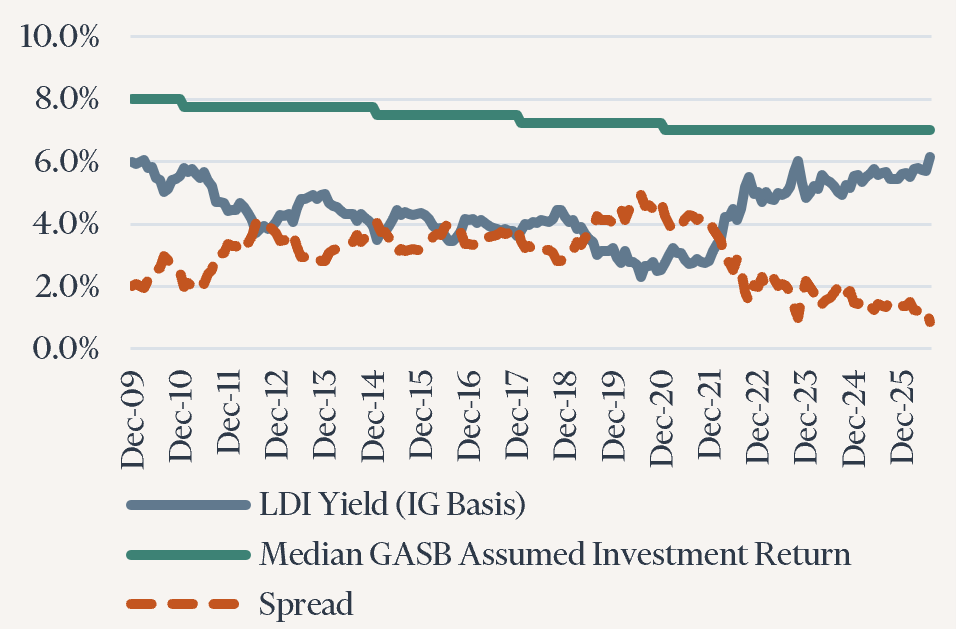
EXHIBIT 2: CERITY PARTNERS’ INSTITUTIONAL CONSULTING’S 2021 VS. 2025 CMAS⁹
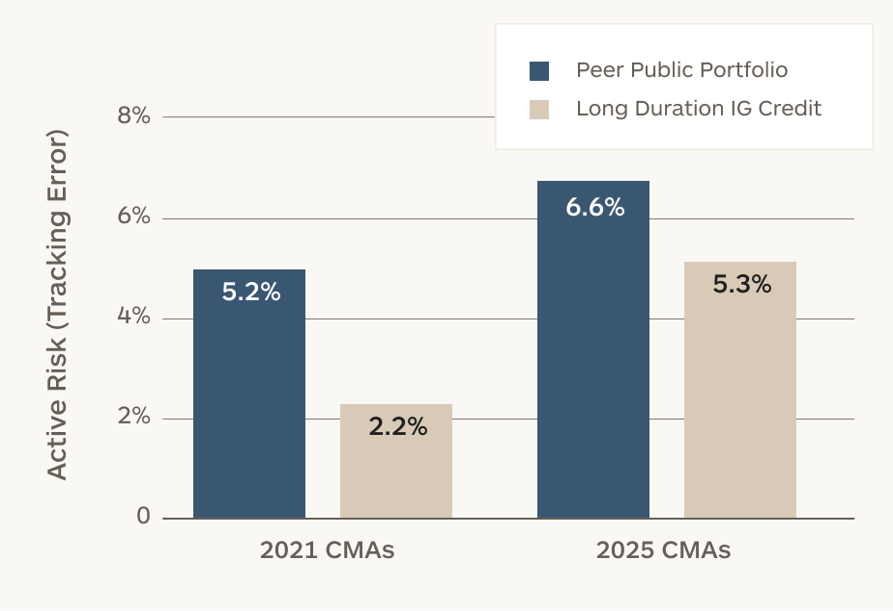
Relative to the highly uncertain outcomes of peer public portfolios that carry tremendous asset-liability mismatch, we believe this may be attractive for certain plans, depending on objectives, constraints, and risks. We also find this opportunity cost to be cheap relative to history. When considering the current capital market environment in combination with the asymmetric risk/return pension profiles discussed earlier, plan sponsors may even be able to implement LDI solutions without increasing the expected contributions needed to support the plan.
Conclusion
Liability driven investing can offer considerable value for many pension plans. Unfortunately, prevailing reporting requirements causes the benefits of LDI to be largely unseen and thereby encourages an asset-only perspective to investing. In this TOI white paper, we discussed how public plan sponsors can better implement LDI solutions to overcome these challenges, discussed the characteristics of pension plans that make LDI beneficial, and shared our perspectives on the current environment to illustrate why LDI may appear relatively attractive today. For more information regarding our views on LDI for public plan sponsors, please reach out to your CPIC consultant.
For more information, read our whitepaper LDI for Public Sponsors.
Sources:
- This TOI uses cashflow matching and LDI interchangeably. Please see the appendix for further discussion.
- The better funding, greater maturity, and presence of PBGC variable rate premiums are additional drivers.
- Full funding on a market basis means there are sufficient assets to guarantee benefits through 1) a cashflow matching portfolio or 2) by transferring the obligations to an insurer.
- Please see the appendix for further discussion of the implications of the two funded status measurements.
- Please see appendix for illustrations of how LDI can reduce a plan’s risk profile.
- Please see the appendix for further discussion of drawdown risk.
- The appendix includes a Monte Carlo simulation where surplus is used to buy a cashflow matching portfolio.
- GASB median returns reflect the Public Plans Database, covering 253 major state and local government pension plans and approximately 95% of public pension membership and assets in the U.S. 2026 return assumptions are not yet available and assumed to be the same as in 2025. LDI yields reflect month-end FTSE Pension Liability Index discount rates, intended to measure the effective yield of a AA zero coupon bond portfolio that matches an illustrative pension liability with duration of 16.0 at 7/31/26.
- Analysis is based on CPIC’s 2021 CMAs and 2025 CMAs. The 2025 CMAs are adjusted to reflect the capital market environment as of 12/31/2024. The return forecasts reflect a peer portfolio for public plans.
- Monte Carlo simulation reflects peer public portfolio for non-cashflow matched assets with 6.6% forecasted return, actuarial return requirement of 6.25%, 5.33% yield to maturity of cashflow matching portfolio, no contributions, and no benefit accruals.
Information and data are as of the date indicated herein and have not been updated to reflect subsequent market conditions.
Cerity Partners Retirement Plan Advisors LLC d/b/a Cerity Partners Retirement Plan Consultants and Cerity Partners Institutional Consulting (“RPC”, “CPIC”, “we,” “us” or “the Adviser”) is registered with the U.S. Securities and Exchange Commission as an investment adviser and is a wholly-owned subsidiary of Cerity Partners LLC. Registration as an investment adviser does not imply any level of skill or training.
The information contained herein is not personalized investment, tax, or legal advice and is for informational purposes only. There is no guarantee that any views or opinions expressed will come to pass. This information is subject to change without notice and should not be considered an offer to sell or a solicitation to buy any security. Past performance is not indicative of future results. Before making any decision that may affect your retirement plan or finances, consult a qualified professional adviser.
For information about the Adviser’s registration status, refer to the Investment Adviser Public Disclosure website at www.adviserinfo.sec.gov. For additional information about the Adviser’s services, fees, conflicts of interest, and related persons, please request our Form ADV Part 2A and Form CRS disclosure documents. Please read these documents carefully before engaging our services.
© 2026 Cerity Partners Retirement Plan Advisors LLC. All rights reserved.
Please read important disclosures here.