

We frequently hear venture capital investments described as “bets” and bristle against this characterization. This is because our mentors in venture capital taught us that gambling is the opposite of investing:
- Gamblers walk into a transaction (the casino) with a rational expectation of losing money, despite the hope of profiting. The thrill of beating the odds drives this activity. But as we’ve all heard, “hope is not a strategy.” Gamblers are subject to house odds, which are stacked against them.
- Investors walk into a transaction (a portfolio company for venture capitalists) with a rational expectation of making more than they put in. This expectation is an investment thesis and relies upon experience to evaluate people, markets, financials, products and services, contracts, economic models, competition, valuations, and more.
While our opinion is that luck is a big factor in venture capital, a fundamental premise of investing is that VCs can influence outcomes with diligence, structure, pricing, and portfolio company management.
Experienced colleagues on our team learned this the hard way by losing money on many investments we led as general partners, in institutional venture capital or as corporate VCs, in the early 2000s. While we had enough “hits,” it was tough sledding. In retrospect, many of the institutional opportunities seem like gambles, even for seed-stage deals. We studied what went right and what went wrong to try to get better at investing, to learn to deliver more predictable outcomes.
Based on these experiences, we believe all entrepreneurs and VCs should ask themselves if they’ve adopted a gambling or investing mentality.
A few years ago, our Cerity Partners Ventures practice held a “salon” — a fancy name for a book club — to discuss The Biggest Bluff, the story of Maria Konnikova, a Columbia University psychology PhD turned professional poker champion.
This book examines how luck and skill combine in the world of professional Texas Hold ’Em poker, and the analogies to venture capital investing are apt. As in venture capital and entrepreneurship, Konnikova notes that “in poker, you can win with the worst hand and you can lose with the best hand… And that, in a nutshell, is why poker is a skilled endeavor rather than a gambling one.”
She explores poker from a practical lens as a player, but also seeks relevant metaphors, including investing:
“For a large majority of fund managers, the selection of stocks is more like rolling dice than playing poker,” says Daniel Kahneman, the Nobel-winning economist. Not only do most funds underperform the market, but the correlation in year-to-year performance is incredibly low. Kahneman continues, “The successful funds in any given year are mostly lucky; they have a good roll of the dice. There is general agreement among researchers than nearly all stock pickers, whether they know it or not — and few of them do — are playing a game of chance.”
Konnikova describes an investment simulation she ran with thousands of participants during her doctoral research, reinforcing the psychological challenge of self-control in activities that blend luck and skill:
Over and over, people would overestimate the degree of control they had over events…. The more they overestimated their own skill relative to luck, the less they learned from what the environment was trying to tell them, and the worse their decisions became…. In other words, the illusion of control is what prevented real control over the game…
The book confirmed our appreciation for the game of poker as the “least gambling” of games of chance. Betting, in poker, should really be treated as a thoughtful, deliberate form of decision making according to Konnikova — just like investing. She explains that in poker, players must consider multiple factors including the cards (the quality of your product or service, and whether the company offers a must-have or nice-to-have solution), your position at the table (the market), the other players (entrepreneurs and co-investors), and even yourself.
Especially relevant for investors is how Konnikova’s poker mentors and guides emphasize the importance of objectivity, in terms of what you can control and what you can’t, as they push her to understand what kind of “hand” she’s playing. Reflecting on her conversations with Frank Lantz, who runs the New York University Game Center, she notes:
For a long time, Lantz was a serious poker player. And one of the reasons he loves the game is that the probabilities are what they are… they force you to confront the wrongness of your intuitions if you are to succeed. Poker pushes you out of your illusions, beyond your incorrect comfort zone — if, that is, you want to win.
Konnikova’s mentor, poker world champion Erik Seidel, introduces her to poker legend “Action Dan” Harrington. Harrington is blunt regarding his views on the need for objectivity when luck and skill combine:
“As a professional gambler, you have to understand: if you don’t have an objective evaluation of what’s going on, you’re a loser… If you don’t understand what’s going on, the game will say, ‘We’re taking your money away from you.’”
If investing is reduced to stock picking, anyone with a checkbook can do it. But venture capital is more than a roll of the dice and requires more skill than a game of chance. There’s a discipline to diligence. There are best practices for deal management. There is methodology and psychology required for successful negotiations. There is knowledge and a lexicon to deal structure. Venture capital is not simply whether an investor happens to like an entrepreneur or believes the technology is novel.
According to Pitchbook, in most venture capital vintages the “house odds” are that you will make 1.3x your money in 10–15 years. That isn’t a very good return. Given the effort involved, you might be better off investing in another asset class unless you have a way to be better than average. This is why experienced limited partners try to identify investors who they believe can generate attractive fund-level returns.
Corporate venture capital demonstrates this principle, since the average program is shut down in about four years. Vibha Gaba, a professor at INSEAD, notes: “It turns out that having at least one team member with venture capital experience on-board brings deep practice knowledge, such as a better handle on how to look for new ideas, how to evaluate early stage start-ups and create contracts, etc. Without the full know-how and mind-set, teams lacking experience with venture capital tended to adapt the VC practices in unhelpful ways.” She continues, “a CVC unit must invest regularly enough so that its managers accrue expertise and self-confidence, reducing their natural propensity to blindly follow the crowd.”
While good investors will often share diligence materials with each other to build syndicates and act quickly, the discipline of investing requires doing your own homework. This means thinking critically about the underlying needs of customers in new markets and not taking a leap of faith just because brand name venture firms promote an opportunity.
As an example, Clubhouse was poised to become one of the biggest companies in the world according to many backers during the pandemic.
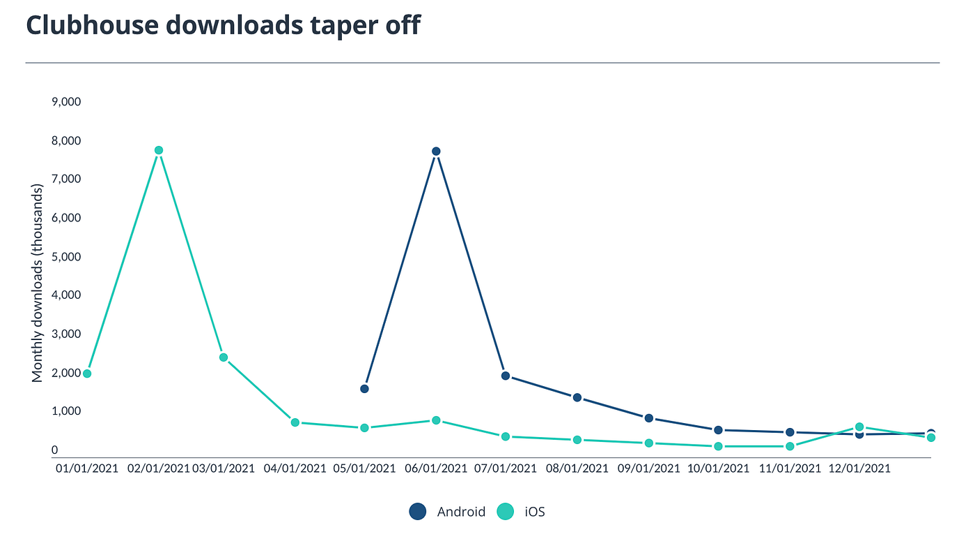
As the rapid rise and fall of Clubhouse consumer adoption illustrates, chasing hot deals is not an investment thesis. Watching entrepreneurs hit plans over time is an important part of the venture capital investment discipline. This should remind us of the importance of arms-length valuations set by new investors in each round. One of the challenges of being a “heat-seeking missile” is the lack of a true target. The missile goes wherever heat appears on the radar, which seems like gambling.
As in poker, some amount of speculation may be useful and even logical from time to time, but investors should be clear-eyed about these decisions, to avoid engaging in the delusion of chance masquerading as skill.
Our experience is that venture capital is a difficult business requiring a combination of luck and specific skill sets. VCs learn not just about entrepreneurs and technologies, but also how to identify, validate, price, structure, manage, and exit transactions. Those who can learn this craft through experience can truly call themselves investors.
Please read important disclosures here.