

In our experience having funded more than 200 startups as of the second quarter of 2026, venture-backed businesses often treat the CFO hire as a late-stage milestone — something to tackle after finding product-market fit, upon raising growth stage equity as implied by a Series B or Series C Preferred financing, or once the team scales past a certain headcount. The reasoning is understandable: finance can seem like overhead when the priority is growth, and experienced CFOs are expensive. But this logic may overweight the price of the hire without fully contemplating the cost of waiting.
The absence of trained finance professionals is more than a gap on the org chart. It can create a series of operational and strategic problems that invisibly compound. The underlying roles of CEOs and CFOs may help explain why.
Offense vs. Defense
At the risk of generalizing, CEOs play offense and CFOs play defense. Each provides a vital function for the startup, and it is difficult for a single person to perform both roles at the same time.
Consider the core activities of the CEO: the job includes setting vision and direction, closing major partnerships and customer relationships, raising capital, recruiting and motivating the senior team, serving as the primary spokesperson for the firm, and so on. These activities require optimism, creativity, and a focus on what might be possible.
In contrast, the job of a CFO demands skepticism, discipline, and a focus on what might go wrong—in other words, defending the business against failures. The position includes planning to facilitate the CEO’s vision and direction, ensuring major partnerships and customer relationships are productive, managing capital, supervising and sometimes firing the team, implementing capabilities so that the firm can deliver on its promises, and more.
In an ideal world, the CEO and CFO are partners, optimizing the startup’s ability to play offense and defense equally well. As such, they should challenge each other and spiritedly debate what helps the company reach its goals predictably, weighing risks vs. upside, and deciding what course of action represents the optimal level of aggressiveness.
Many investors have experienced what happens when a startup is “all offense and no defense,” because every startup has a founding CEO, but not every venture-backed business has hired a CFO. In our view, this imbalance can dramatically increase the chances of startup failure, especially in scenarios when funds are exhausted prior to achieving critical milestones.
Without trained finance professionals, the startup may learn to operate in perpetual chaos mode chasing opportunity. Cash budgets may be inaccurate. Overly optimistic forecasts may generate frustration if results are less stellar. Disorganized fundraising processes may distract the CEO from other key responsibilities. Each of these problems can be solved, but together they may form a pattern that erodes confidence — internally and externally — when the startup is still fragile.
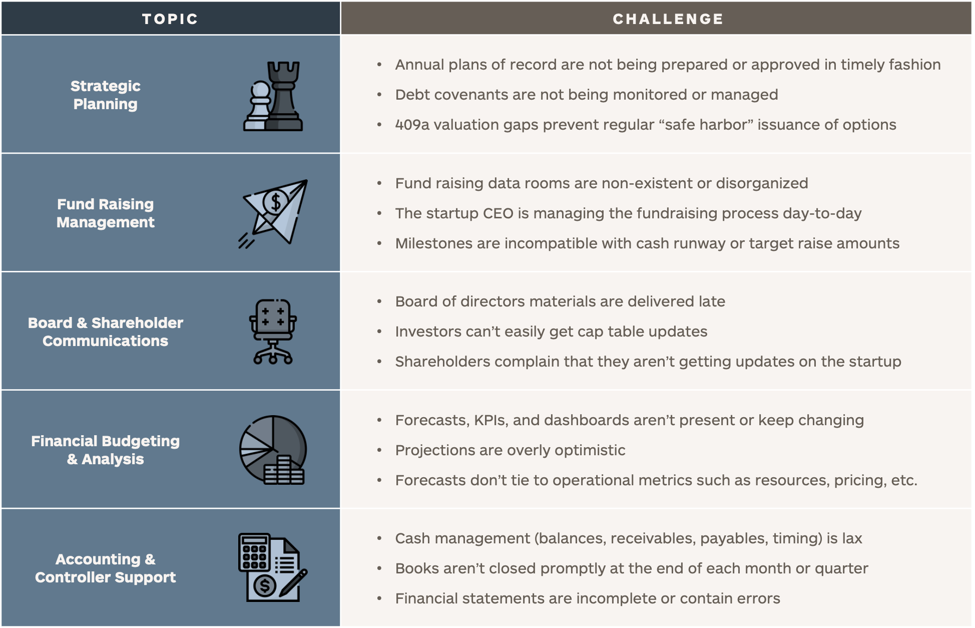
Signals that a startup may need finance support
For founders and investors assessing a startup’s financial capabilities, the following headaches may actually be red flags that justify investment in professionalized help:
Strategic Planning
Annual plans of record create a baseline to measure performance and allocate resources, and when a startup can develop realistic plans and achieve them on schedule, the CEO builds confidence with investors and the board. Of course, in the absence of proper planning, that same potential confidence is eroded. Potentially more acutely, unmonitored debt covenants can trigger technical defaults with sometimes fatal consequences to the business. Financial professionals are also responsible for ensuring independent 409A valuations are conducted, and these allow the board to issue stock options to employees under a “safe harbor” that protects everyone involved. Delays can cause compliance exposure and frustration for equity grantees. Ultimately, lack of competence at these types of functions can erode morale and retention.
Fundraising Planning and Process Management
A disorganized data room is a manageable problem, but first impressions matter during a process where investors have choices about where to provide funding. More substantively, when a CEO is personally managing the logistics of a fundraising process — coordinating document requests, tracking investor communications, updating financial schedules, etc. — that is time and attention being diverted from running the business. In our experience, the fundraising process benefits from a dedicated operator who can “keep the trains running on time,” so that the CEO can focus on what he or she does best: selling.
Board of Directors and Shareholder Reporting
Investors and board members depend on timely, accurate information to fulfill their own governance responsibilities. When cap table updates are difficult to obtain, or when board materials are consistently delivered late, the problem is not merely administrative. This may signal a lack of prioritization of investor relationships — which may come back to haunt the startup when fresh capital infusions are required. Consistent, proactive reporting is one of the startup’s primary tools for maintaining investor confidence prior to the growth stage.
Financial Budgeting and Analysis
A startup lacking budget and forecasting processes is navigating without instrumentation. When KPI dashboards are absent, inconsistent, or regularly revised without explanation, it becomes difficult for management, the board, and investors to evaluate whether the business is on track. This amplifies the normal uncertainty of early-stage companies. Projections that are wildly unrealistic — including assumptions about growth, burn rate, or unit economics that don’t hold up to basic scrutiny — are another risk that can undermine the startup’s ability to raise the capital it needs to pursue its vision and mission.
Accounting and Controller Support
Without financial leadership, key functions that safeguard financial health can also be overlooked. Closed books are a prerequisite for reliable decision-making, but our experience on dozens of startup boards is that even basic competences can become a struggle. If a startup’s leadership team cannot answer questions about current cash balances or explain net receivables and payable balances, investors may be challenged to secure follow-on funding for their portfolio companies in a pinch.
If your startup is exhibiting any of the above issues, it may be time to consider bringing in help. While the near-term expense may not be budgeted, the success of the overall enterprise may silently be at risk. Our own experience is that in many cases, once finance professionals are finally in place, they may spend the first year or more cleaning up problems, rather than helping the startup win in its niche. It should stand to reason that the earlier a startup can develop “good financial habits,” the more efficiently its financial and human capital and efforts can be applied.
Some startup leaders believe that a part-time bookkeeper or a spreadsheet-fluent co-founder can fill the finance role in the early stages. In some cases, that may be true, and some financial fluency is better than none. But there is a meaningful difference between recording transactions and providing the financial judgment to guide a business. A CFO-level hire should bring the ability to anticipate financial inflection points before they become crises. A seasoned CFO is also more likely to have the gravitas to go toe-to-toe with the startup’s CEO, which hopefully leads to better decision making, and more reliable success for the startup.
Please read important disclosures here.