

The views expressed here are the author’s own and do not necessarily reflect those of Cerity Partners LLC or its Investment Committee.
Did you invest in a company privately, before it went public? Or did you at least get an allocation to the IPO, with the chance to participate in the “first-day pop”?
A company goes public to enormous fanfare. Another large-capitalization name gets added to the major indices. Staggering wealth is created for a small number of founders and employees.
The instinct to chase shiny objects is physical—and it is the same instinct that surfaced with the dot-com IPOs of the late 1990s and every hot deal since. In an earlier era, it was railroad stocks. The company names, people, and stories change, but the magnetic attraction does not.
The temptation is real, and the companies are often extraordinary. But there is a quiet error buried inside the excitement, and it is worth naming plainly: A great company and a great investment are not the same thing. Whether they coincide depends entirely on price—and they are least likely to coincide at the price the crowd is willing to pay.
The IPO is only the most vivid version of a much broader habit. The habit is the chase for outperformance itself—for “alpha,” the industry’s word for beating the market. Here is the question almost no one stops to ask: Outperformance relative to what?
Somewhere along the way, our industry—and its performance culture—substituted the market for your life. It made the benchmark the scoreboard. It taught a generation of investors to measure success not by whether they could fund a retirement, educate a child, or leave something behind, but by whether they beat an index over a span of months.
That substitution is the original mistake. As investor behavior expert and influential financial advisor Nick Murray puts it, when the focus of our portfolio shifts from our financial goals to the markets themselves, we commit the original sin—and every return-destroying behavioral instinct comes rushing in behind it.1
Outperformance, in other words, is not a financial goal. Financial goals describe how we want our money to serve our lives. Beating an index describes nothing about a life at all.
Now suppose you set that objection aside and decided to play the game anyway—to win the market rather than simply own it. The evidence on your odds is not close.
Over the 20 years through 2025, roughly nine in 10 large-cap US stock funds failed to beat their benchmarks.2
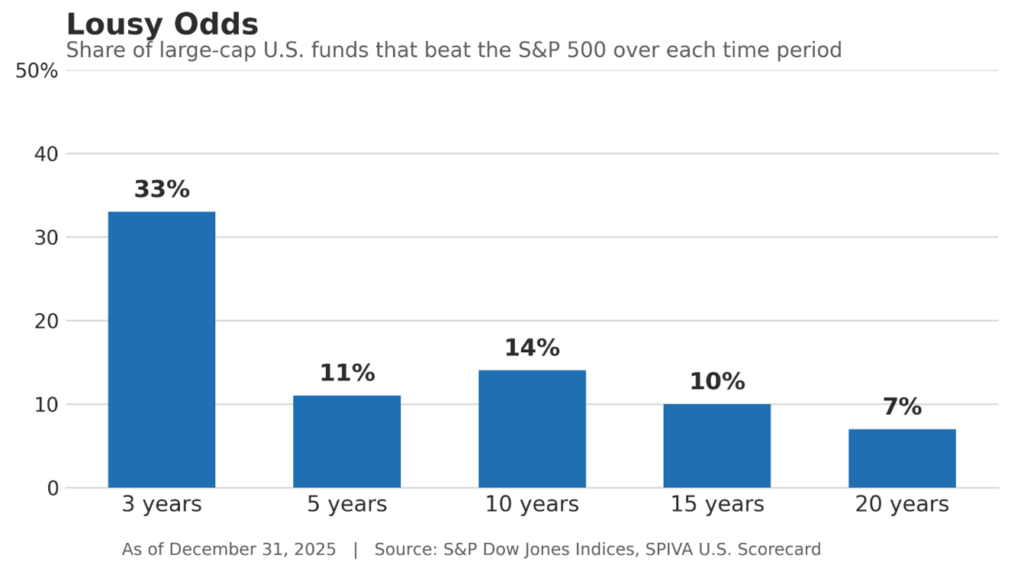
And the rare winners do not stay winners; outperformance in one period is, more often than not, the residue of luck rather than the signature of skill. By the end of 2025, only 2.4% of large-cap funds had stayed in the top half of their peers for five straight years, and no domestic top-quartile fund repeated that feat over five years—a record worse than chance alone would produce.3
This is neither bad luck nor bad management. It is arithmetic. As Nobel laureate William Sharpe observed decades ago, active managers as a group are the market; before costs they must, in aggregate, match it, and after their fees they must, in aggregate, trail it. Nobel laureate Eugene Fama and his longtime collaborator Kenneth French later put numbers to the residue of skill that remains and found that even managers with long winning records are far more likely to have been lucky than good.4
A century of stock returns rests on a handful of names
The deeper reason is structural, and it is the most underappreciated fact in the financial advisory industry. Over the last century, a vanishingly small number of companies produced essentially all of the market’s wealth. Hendrik Bessembinder, a finance professor at Arizona State University, recently studied 100 years of US stock returns and found that just 46 firms accounted for half of all the net wealth ever created and that well over half of all stocks did worse than Treasury bills over their lifetimes.5 Stock market whales are very rare. This pattern holds in the present; more than three-quarters of the stocks in the S&P 500 lagged the index itself over the most recent 20-year period.6
The winners are real, but they are needles, and they are nearly impossible to identify in advance within the market’s haystack. This is the honest concession the index skeptic is owed: Genuine skill exists. A small number of managers truly do possess it. But it is exceedingly rare, it is nearly indistinguishable from luck until long after the fact, and identifying its possessor in advance—when the bet must actually be placed—is a different and far harder problem than confirming it in hindsight.
The most candid expression of this point comes from someone with every incentive to argue the other side. Dan Rasmussen, who runs the quantitative investment firm Verdad Advisers and manages active strategies for a living, notes that US large-cap equities are the largest, most liquid, most heavily researched market in the world—and therefore the hardest one in which to find an edge.
Over the 10 years through 2025, only 8.1% of active US large-blend funds both survived and beat their index. Rasmussen’s conclusion is not that active management never works, but that it does not work here. The case for indexing most US large-cap exposure, he writes, is nearly airtight.7 To own the market is to be guaranteed the few that matter. To pick is to bet against the odds that you have found them.
Here, then, is the question I would put to any investor weighing the chase: Who is better off in practical, real-world terms—the investors who beat their benchmark by a point but whose financial plans do not work or the investors who trail their benchmark by a point but whose plans do work?
The costliest mistakes never show up on the scoreboard
The answer is obvious the moment the question is asked, and it dissolves the whole enterprise. The benchmark was never the point. The plan was always the point. And the true cost of keeping the wrong scoreboard is not the alpha a manager fails to deliver; it is the return investors destroy by chasing it.
Many investors buy funds after strong runs and sell them after weak ones, so their dollars are absent for much of the return they were chasing. The result: Average fund investors trail the very funds they own by more than a percentage point a year—a self-inflicted gap, paid year after year, that no benchmark ever records.8 A coherent date- and dollar-specific plan is the only strategy that funds a life, and the portfolio exists as the medium to fund it—not the other way around. When the plan is sound and unchanged, there is nothing to chase and nothing to do but let it work.
The next great company will go public, and the one after that. The names will be dazzling, and the stories will be true. None of it changes the only question that matters, which is not whether you beat the market this year, but whether, decades from now, your plan works.
- Nick Murray. “The Fatal Disconnect.” August 2015. ↩︎
- S&P Dow Jones Indices LLC, SPIVA® US Scorecard: Year-End 2025, Report 1a (“Percentage of US Equity Funds Underperforming Their Benchmarks, Based on Absolute Return”). Data as of December 31, 2025. The All Large-Cap Funds category underperformed the S&P 500 over the 20-year horizon at a rate of 92.89%. ↩︎
- S&P Dow Jones Indices LLC, US Persistence Scorecard: Year-End 2025. Data as of December 31, 2025. ↩︎
- Spencer Jakab, “Why This Isn’t a Stock Picker’s Market,” The Wall Street Journal, November 21, 2025. The persistence figures derive from the S&P Dow Jones Indices US Persistence Scorecard; the structural argument summarizes William F. Sharpe, “The Arithmetic of Active Management,” Financial Analysts Journal (1991), and Eugene F. Fama and Kenneth R. French, “Luck Versus Skill in the Cross-Section of Mutual Fund Returns,” Journal of Finance (2010). ↩︎
- Hendrik Bessembinder, “One Hundred Years in the US Stock Markets,” W.P. Carey School of Business, Arizona State University, working paper, March 21, 2026. Findings: aggregate net shareholder wealth creation of $90.96 trillion, 1926–2025; just 46 firms account for half of that total; 17,197 of 29,081 firms (59.13%) reduced shareholder wealth relative to five-month Treasury bills over their listed lifetimes; the top 1,082 firms (3.72%) account for 100% of net wealth creation. ↩︎
- Spencer Jakab, “Want To Feel Dumb? Try Picking Stocks,” The Wall Street Journal, February 2, 2026, citing S&P Global. ↩︎
- Dan Rasmussen, “The Most Efficient Market,” Verdad Weekly Research, July 13, 2026, citing Morningstar’s US Active/Passive Barometer. ↩︎
- Spencer Jakab, “You’re More Like Warren Buffett Than You Think,” The Wall Street Journal, May 5, 2025, citing Morningstar. ↩︎
Please read important disclosures here.

