

“Simplicity has a way of improving performance through enabling us to better understand what we are doing.” — Charlie Munger1
Over the course of a long career on Wall Street, something interesting happens. The list of things that feel important gets shorter, not longer. The longer you work with real people, real money, and real consequences, the less impressed you become by cleverness—and the more you come to value simplicity, clarity, discipline, and restraint.
The financial services industry often moves in the opposite direction. It emphasizes novelty, complexity, and an ever-expanding set of variables to monitor, optimize, and explain. And yet complexity does not always equate to improvement in proportion to the effort.
In fact, we believe there are three main drivers of long-term success for the individual investor:
- A coherent financial plan
- Thoughtful asset allocation
- Investor behavior
They are deeply interdependent, but they are not equally forgiving.
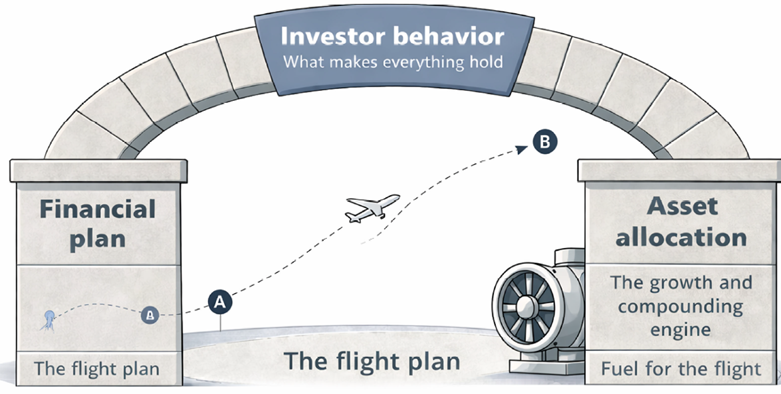
Source: Cerity Partners
The financial plan: Orientation before outcomes
At the high end of the advisory business, a financial plan is table stakes. Most serious advisors are modeling cash flows, stress-testing assumptions, and projecting a range of outcomes. The plan, therefore, is a deliverable but not the most valuable service. It is the organizing framework used to fund goals and optimize ending portfolio values.
In our philosophy, the portfolio exists as the medium to fund the plan—not the other way around. Investments are the means, not the objective. The plan defines goals, priorities and time horizons clearly enough that decisions can be made consistently over decades, not revised in response to headlines.
For that reason, our plans never depend on outperformance, or “alpha,” to work. They do not assume superior forecasting, market timing, stock picking, or manager selection. They are built on long-term assumptions that already incorporate the full range of historically normal market outcomes—including sometimes gut-wrenching volatility, corrections, and bear markets.
This is why the plan does not change—and never changes—simply because markets become uncomfortable. If goals, assumptions, and circumstances remain the same, the plan remains intact. And when the plan doesn’t change, the portfolio doesn’t either. When markets get nasty, my message is always the same: We planned for this.
This is why we put so much emphasis on planning. It creates the framework and confidence to stay still when everything around you says, “Move!” A good financial plan is like a flight plan: You know your destination, and you know there’s likely to be some turbulence along the way. So when the ride gets bumpy, you’re prepared. It may still feel uncomfortable, but you don’t jump out of the plane. You stay in your seat and trust the process.
Asset allocation: The workhorse and a deliberate act of subtraction
There are countless ways to construct a portfolio. In our practice, we have chosen to make asset allocation a deliberate act of subtraction—removing complexity and unnecessary friction in favor of clarity, discipline, and durability. We construct each client’s core portfolio without reliance on specialized vehicles, illiquidity premiums, or ongoing tactical intervention. This is not an absence of sophistication but the result of judgment, and it is grounded in diversification, cost control, tax efficiency, and behavioral durability.
In the real world, most investors need:
• Cash for day-to-day expenses and near-term emergencies
• Bonds to fund known commitments due within five years
• Equities to preserve and grow long-term purchasing power
Our client portfolios are deliberately simple. You know exactly what you own and why you own it. We view equities—the leading companies in the world—as a distinctive asset class: the only one that fully captures the ingenuity of human progress. Over long periods, the value created by innovation and enterprise has accrued to the owners of businesses, not to their lenders, across market cycles and economic regimes.
Too many investors misunderstand what it means to be invested in equities. They mistake volatility for risk.
Risk is the permanent loss of capital—not temporary declines.
Volatility is the price we pay for long-term returns. It’s not a flaw of the system; it’s a feature of how markets function and the main reason why equities have historically delivered higher returns over the long run compared to less volatile asset classes. Without volatility, there’d be no excess returns.
Behavior: Where outcomes are decided
If thoughtful plans and well-constructed portfolios were enough, long-term investing would be easy. But there’s more to it than that. The difference between successful long-term investors and unsuccessful ones is rarely intelligence or sophistication. It comes down to behavior—how decisions are made in times of uncertainty, volatility, and emotional stress. What’s especially challenging is that investing is the one area of economic life where our instincts consistently work against us.
In nearly every other context, we behave countercyclically. For example, when prices are discounted, we perceive greater value and step up purchases. When it comes to investing, it’s the exact opposite. Even though value and price are inversely correlated, humans are procyclical when it comes to investing. We incorrectly perceive that higher prices mean lower risk and safer investments. As Cullen Roche, Founder and Chief Investment Officer of Discipline Funds, astutely observed, “The stock market is the only market where things go on sale and all the customers run out of the store.” This is a durable feature of human psychology based on our evolutionary brain wiring. And this is where the true value of a great advisor emerges.
Our role is not to predict specific market behavior, which is unknowable, or to fine-tune portfolios at the margin. It is to serve as a behavioral investment counselor—providing perspective when emotions run high, reinforcing discipline when conviction wavers, and helping clients act consistently with their long-term plans rather than short-term instincts. The value of this role compounds quietly over time. Avoiding even one major behavioral mistake can be worth many multiples of the fees paid over the course of a long relationship. In that sense, good advice functions as inexpensive insurance against the mistakes that matter most.
The takeaway
Long-term investment success is rarely about doing more. Instead, it is about doing a few essential things well—and continuing to do them when it becomes uncomfortable. A coherent financial plan provides direction. Thoughtful asset allocation provides structure. But it is behavior, under real-world conditions, that ultimately determines whether either one delivers on its promise. The quiet work of advising is integrating all three—and helping them endure.
To discuss how these principles apply to your own financial plan, reach out to our office directly at 303-721-7000 or visit our practice page to request an introduction.
Source: 1Peter Bevelin, Seeking Wisdom: From Darwin to Munger, 2003
Please read important disclosures here.

