
Download this week’s full edition!
Futures markets see a 90% chance of a 25-basis-point hike at this week’s Federal Open Market Committee meeting, and while central banks rarely stop at one hike, equities have historically weathered first hikes well and current economic strengths—insulated from rate changes—suggest tightening may avoid triggering a recession.
What caught our eyes this week
What comes after a rate hike?
Futures markets are placing 90% odds that we get a 25-basis-point rate hike at this week’s FOMC meeting. Assuming markets are correct, two important questions follow: (1) What comes after that? and (2) Can markets handle it? Typically, central banks rarely deliver just one rate hike. Bond markets are currently positioned for a mild tightening campaign with a handful of hikes over the next year. However, it’s clear that Federal Reserve (Fed) Chair Kevin Warsh would like us to throw out our old playbooks. If markets send a signal that further tightening is no longer necessary, we might end up with the rare “one and done.” As for the first hike, equity markets have historically held up surprisingly well, with positive returns on average three and six months after the first hike in eight occurrences going back to 1983. The problem—and genesis of the adage “Bull markets don’t die of old age”—is when the Fed tightens to the point of recession, which is far from a foregone conclusion in today’s case. We don’t think inflation trends are so off target that they can’t be nudged in the right direction without a recession. Also, many of the underlying sources of economic strength (e.g., AI-related capital expenditures) are relatively insulated from changes in interest rates and should keep tighter monetary policy from slowing the economy too much and too fast.
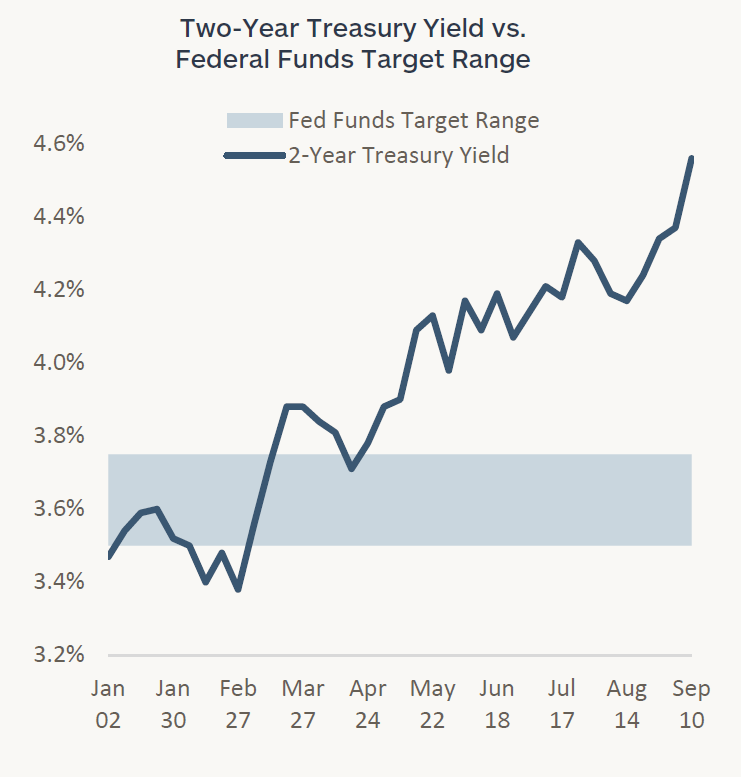
CHART OF THE WEEK: Cerity Partners, YCharts, CME FedWatch as of 9/14/2026
Past performance does not guarantee future results.
Please read important disclosures here.