
Download this week’s full edition!
After a five-year stretch of roughly 0% returns as markets adjusted away from near-zero interest rates, today’s higher starting yields give intermediate-duration bonds both solid income and an asymmetric payoff, since a further 1% rise in yields would leave returns about flat while a 1% decline could produce a double-digit gain.
What caught our eyes this week
The path forward for fixed income
Bonds have had a tough go at it lately. The Bloomberg US Aggregate index has around a 0% return over the past five years—a byproduct of bond markets recalibrating away from the zero-interest-rate policy environment of the post–Global Financial Crisis era. Looking forward, higher starting yields don’t just mean higher income. They also add significant cushion against further yield increases. For example, if yields for the Bloomberg US Aggregate index go up another 1% from 5.5% today, total return would be roughly flat after a year. In other words, the income earned and the price losses would offset each other. But if yields fall 1%, the index could deliver a double-digit return over the next year. We don’t know where the top is for rates, but we do know that as it stands today, intermediate-duration fixed income offers an attractive asymmetry of return on top of a solid income component.
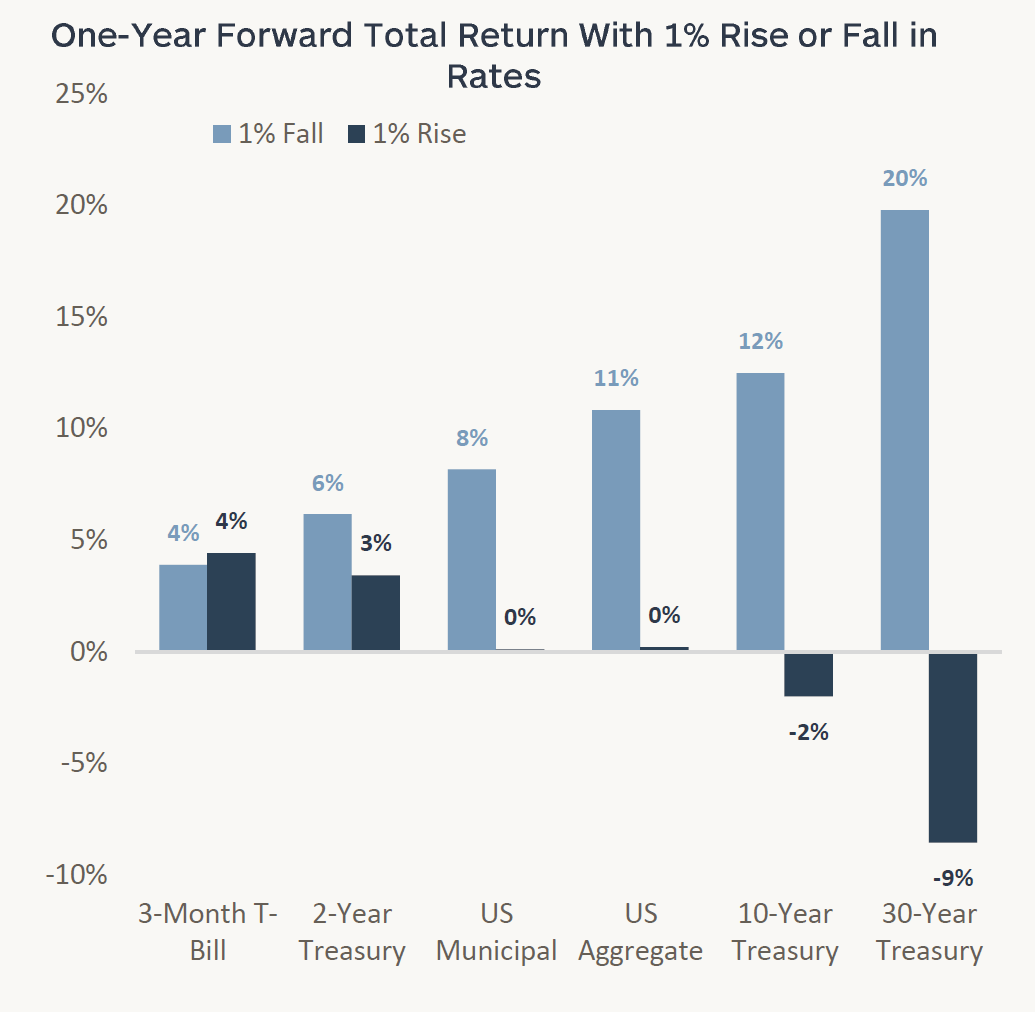
CHART OF THE WEEK: Cerity Partners, FactSet, as of 10/9/2026. Asset classes represented by the following indices: Bloomberg 3 Month T-Bill, Bloomberg US Treasury Bellwethers (2 Y), Bloomberg Municipal Bond Blend 1-10 Year (1-12 Y), Bloomberg US Aggregate, Bloomberg US Treasury Bellwethers (10 Y), Bloomberg US Treasury Bellwethers (30 Y). Total returns reflect index-level duration and convexity, but not the impact of any potential credit losses or changes in credit spreads.
Past performance does not guarantee future results.
Please read important disclosures here.