

This summer, clients and prospective clients gathered in Seattle for the 2026 Cerity Partners Institutional Client Summit. The theme—“Forty Years Forward: Continuing Trust, Expanding Capability”— framed two days of discussion on markets, portfolio construction, manager oversight, and questions that are top of mind for institutional investment professionals in the current environment.
Cerity Partners Institutional Consulting (CPIC) gathered thought leaders from within their practice and beyond to share insights on topics important to their clients and prospective clients:
- Ian Toner, CPIC’s Head of Investments, sat down with investment
–luminary Howard Marks to discuss the current market environment and key issues facing the industry. - CPIC’s Practice Leader, Jeffrey MacLean, had a candid conversation with Cerity Partners CEO Kurt Miscinski about the firm’s future and why the Cerity Partners and Verus merger made sense for clients and colleagues.
- Jim Lebenthal, Cerity Partners’ Chief Market Strategist, and Ian Toner explored the complexities facing institutional investors in today’s market.
- Senior Principal Samantha Grant spoke with four chief investment officers across sectors to discuss the issues most pertinent to them.
Included below are insights from other select sessions at the summit.
Has private equity lost its edge?
Investment committees have had reason to scrutinize private equity. Median returns have trailed public markets, distributions have slowed, and illiquidity has worn on patience even as allocations have grown.
Much of the shortfall, however, traces to a handful of stocks. Measured against the Russell 3000 excluding the Magnificent 7, US private equity outperformed by 4.3% over the 10 years through 2025.¹ Other indicators also show potential for private equity. Since 1990, following instances when the rolling 10-year private and public returns have converged, private equity has gone on to outperform—for 18 years following the 1998 convergence, and for three years following 2020.² The two converged again in 2025.
Liquidity is also improving. After a trough from 2022 through 2024, 2025 produced the second-largest annual US private capital exit volume on record, helped by an opening IPO window.³
None of these factors reduce the importance of manager selection. The spread between top- and bottom-quartile managers is far wider in private equity than in any public asset class, so the resources to identify and access top-tier managers matter more than elsewhere in a portfolio.⁴
—Faraz Shooshani, Partner and Head of Private Markets; Chris Shelby, Senior Principal, Private Markets; Nat Fraser, Partner and Co-Head of Private Capital
The big levers: Winning with asset allocation
Industry research has found that asset allocation accounts for more than 90% of the variation in long-term institutional portfolio performance.5 Manager selection and market timing, while important, tend to play a smaller role on average. While a growing menu of asset classes, including illiquids, alternatives, and real assets, have added complexity to the job of institutional investors, the importance of asset allocation remains front and center.
Whatever the asset class mix in a portfolio, outcomes are largely driven by exposure to a small set of fundamental risks—equity, rates, credit, etc. Portfolios become easier to understand when viewed through those exposures, rather than through asset class labels.
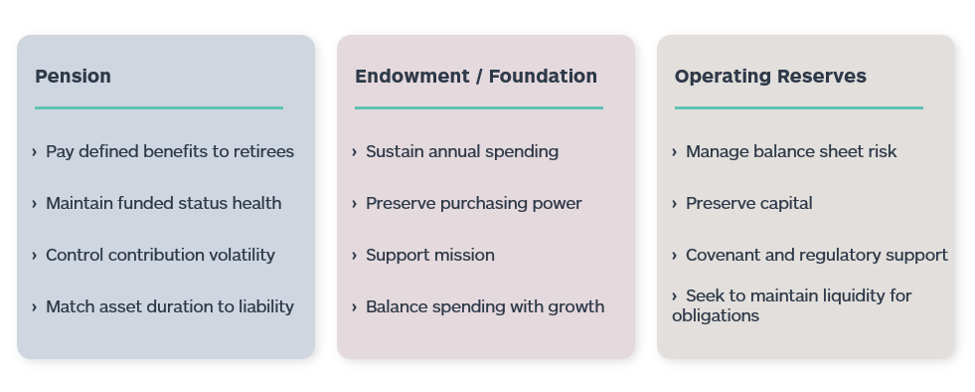
Institutional objectives tend to revolve around future liabilities or spending goals. On an asset-only basis, allocation is a risk-and-return exercise. On an enterprise basis, a portfolio is measured against the objectives it exists to fund.
Establishing a thoughtful asset allocation provides limited value if an institution is unable to stick with their plan through difficult market environments. Every strategy will be tested. Structuring a portfolio that can weather different storms is essential, and being mentally prepared for those inevitable storms can serve institutions well.
Markets may surprise us. Managers may outperform and underperform. Economic regimes will change. But institutions that connect their asset allocation to their mission, liabilities, and enterprise objectives put themselves in the best position to succeed.
—Thomas Garrett, Senior Principal, Strategic Research; Dan Hougard, Principal, Actuarial Consultant; Tim McEnery, Partner and Senior Consultant
Cut bait or stay the course?
Selecting an investment manager strategy means underwriting a process—organization and team, philosophy and edge, portfolio construction, risk controls, and performance expectations. Because a strategy is assessed on these dimensions, not just near-term results, the right time to define what would trigger termination is before the investment is made, not after performance issues arise.
Evaluating a struggling strategy starts with identifying what is driving the underperformance. One possibility is that it reflects broader market themes. Style and factor leadership can persist for years, and underperformance consistent with the stated approach and the prevailing market backdrop often warrants patience rather than action. Diversification across asset classes, styles, and strategies can make patience viable.
Separately, it is prudent to watch for developments that could compromise the process itself, regardless of whether they are visible in performance. These include organizational disruption, style drift, a shift in philosophy, meaningful asset growth or decline, and failures in governance or risk management. If unaddressed, these developments can undermine the original investment rationale and eventually surface as underperformance. Therefore, they warrant decisive action even before performance deteriorates.
—Vincent Francom, Senior Principal, Public Markets; Brian Kwan, Partner and Senior Consultant; Patrick Machell, Principal, Public Markets
To learn more about Cerity Partners Institutional Consulting practice, visit our website.
Footnotes
1. FTSE US Private Equity; includes Buyout, Fund of Funds, Growth Equity, Secondary Funds, Venture Capital. As of 12/31/2025. Past performance is not indicative of future results.
2. FTSE Global Private Equity; includes Buyout, Fund of Funds, Growth Equity, Secondary Funds, Venture Capital. Analysis includes annual returns for all calendar years from 1981 through 2025, evaluated on a 10 year rolling basis. As of 12/31/2025.
3. Greenhill’s Global Secondary Market Review, as of 12/31/2025.
4. eVestment Alliance and Refinitiv C|A. Public equity, fixed income, and hedge fund universes reflect annualized time-weighted returns (TWRs) for the 15 years ending June 30, 2023; private equity and real estate reflect internal rates of return (IRRs) since inception through December 31, 2024, vintage years 2006–2021. IRRs and TWRs use different methodologies and are not directly comparable.
5. Brinson, G. P., Singer, B. D., & Beebower, G. L. (1991). “Determinants of portfolio performance II: An update.” Financial Analysts Journal, 47(3), 40–48.
Cerity Partners Retirement Plan Advisors LLC d/b/a Cerity Partners Retirement Plan Consultants and Cerity Partners Institutional Consulting (“RPC”, “CPIC”, “we,” “us” or “the Adviser”) is registered with the U.S. Securities and Exchange Commission as an investment adviser and is a wholly-owned subsidiary of Cerity Partners LLC. Registration as an investment adviser does not imply any level of skill or training.
The information contained herein is not personalized investment, tax, or legal advice and is for informational purposes only. There is no guarantee that any views or opinions expressed will come to pass. This information is subject to change without notice and should not be considered an offer to sell or a solicitation to buy any security. Past performance is not indicative of future results. Before making any decision that may affect your retirement plan or finances, consult a qualified professional adviser.
For information about the Adviser’s registration status, refer to the Investment Adviser Public Disclosure website at www.adviserinfo.sec.gov. For additional information about the Adviser’s services, fees, conflicts of interest, and related persons, please request our Form ADV Part 2A and Form CRS disclosure documents. Please read these documents carefully before engaging our services. © 2026 Cerity Partners Retirement Plan Advisors LLC. All rights reserved.
Please read important disclosures here.